Ch.10 - Structure and Synthesis of Alcohols
Wade - Organic Chemistry 9th Edition
Wade9th EditionOrganic ChemistryISBN: 9780135213728Non è quello che usi tu?Cambia libro di testo
Capitolo 10, Problema 17a

Show how you would add Grignard reagent to acid chloride or ester to synthesize the following alcohols.
a. Ph3C–OH

Guida verificata passo dopo passo
1
Step 1: Identify the target alcohol structure, Ph3C-OH, which is triphenylmethanol. This alcohol has a hydroxyl group attached to a carbon bonded to three phenyl groups.
Step 2: Recognize that Grignard reagents are organomagnesium compounds (R-MgX) that act as nucleophiles. They can attack electrophilic carbonyl groups in acid chlorides or esters to form alcohols.
Step 3: Select the appropriate Grignard reagent for the synthesis. To form Ph3C-OH, use phenylmagnesium bromide (Ph-MgBr) as the Grignard reagent. This reagent will provide the phenyl groups needed for the final alcohol.
Step 4: Choose the starting material. Acid chlorides or esters can be used. For this synthesis, triphenylmethyl chloride (Ph3C-Cl) or an ester derivative of triphenylmethanol can serve as the starting material.
Step 5: Perform the reaction. Add the Grignard reagent (Ph-MgBr) to the acid chloride or ester under anhydrous conditions. The Grignard reagent will attack the carbonyl carbon, forming an intermediate that hydrolyzes upon addition of water or acid to yield the desired alcohol, Ph3C-OH.

Risposta video verificata per un problema simile:

Questa soluzione video è stata consigliata dai nostri tutor come utile per risolvere questo problema.
Durata del video:
7m

Concetti chiave

Ecco i concetti essenziali che devi comprendere per rispondere correttamente alla domanda.

Grignard Reagents

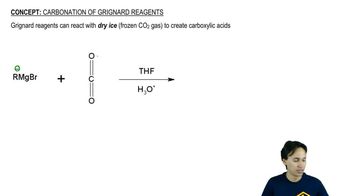
Grignard reagents are organomagnesium compounds represented as R-MgX, where R is an organic group and X is a halogen. They are highly reactive nucleophiles that can add to electrophiles, such as carbonyl compounds, to form new carbon-carbon bonds. In the context of synthesizing alcohols, Grignard reagents react with carbonyl groups in acid chlorides or esters to yield alcohols after hydrolysis.
Video consigliato:
02:12
Carbonation of Grignard Reagents

Nucleophilic Addition

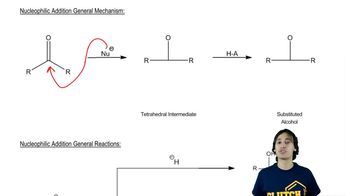
Nucleophilic addition is a fundamental reaction mechanism in organic chemistry where a nucleophile attacks an electrophilic carbon atom, typically found in carbonyl groups. In the case of Grignard reagents, the nucleophile (R-MgX) attacks the carbonyl carbon of an acid chloride or ester, leading to the formation of a tetrahedral intermediate. This step is crucial for the synthesis of alcohols from these carbonyl-containing compounds.
Video consigliato:
08:27
Nucleophilic Addition

Hydrolysis of the Intermediate

After the nucleophilic addition of a Grignard reagent to an acid chloride or ester, a tetrahedral intermediate is formed. This intermediate can then undergo hydrolysis, typically by adding water or an aqueous acid, to yield the final alcohol product. This step is essential as it converts the magnesium alkoxide intermediate into a stable alcohol, completing the synthesis process.
Video consigliato:
04:31
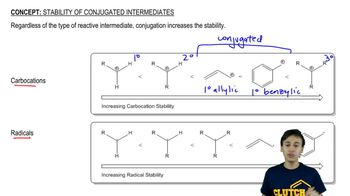
Stability of Conjugated Intermediates