Ch.10 - Structure and Synthesis of Alcohols
Wade - Organic Chemistry 9th Edition
Wade9th EditionOrganic ChemistryISBN: 9780135213728Non è quello che usi tu?Cambia libro di testo
Capitolo 10, Problema 19a

Show how you would synthesize the following alcohol by adding Grignard reagents to ethylene oxide.
(a) 2-phenylethanol

Guida verificata passo dopo passo
1
Step 1: Understand the reaction mechanism. Grignard reagents are organomagnesium compounds (R-MgX) that act as nucleophiles. They attack electrophilic centers, such as the carbon in ethylene oxide, to form new carbon-carbon bonds.
Step 2: Identify the Grignard reagent needed. To synthesize 2-phenylethanol, the Grignard reagent should contain a phenyl group (C₆H₅). Therefore, the Grignard reagent to use is phenylmagnesium bromide (C₆H₅-MgBr).
Step 3: React the Grignard reagent with ethylene oxide. The phenylmagnesium bromide will attack the electrophilic carbon in ethylene oxide, opening the epoxide ring and forming a new bond between the phenyl group and one of the carbons in the ethylene oxide.
Step 4: Perform hydrolysis. After the Grignard reagent reacts with ethylene oxide, the intermediate product is treated with water or dilute acid to protonate the oxygen atom, resulting in the formation of 2-phenylethanol.
Step 5: Verify the product structure. The final product should have a phenyl group attached to a two-carbon chain ending in an alcohol group (-OH), which matches the structure of 2-phenylethanol.

Risposta video verificata per un problema simile:

Questa soluzione video è stata consigliata dai nostri tutor come utile per risolvere questo problema.
Durata del video:
5m

Concetti chiave

Ecco i concetti essenziali che devi comprendere per rispondere correttamente alla domanda.

Grignard Reagents

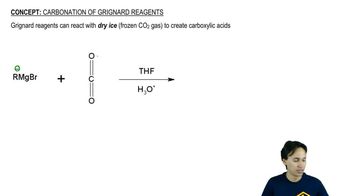
Grignard reagents are organomagnesium compounds represented as R-MgX, where R is an organic group and X is a halogen. They are highly reactive and serve as nucleophiles in organic synthesis, allowing for the formation of carbon-carbon bonds. When reacted with electrophiles, such as carbonyl compounds or epoxides, they can lead to the formation of alcohols, making them essential in synthetic organic chemistry.
Video consigliato:
02:12
Carbonation of Grignard Reagents

Ethylene Oxide

Ethylene oxide is a three-membered cyclic ether that is highly reactive due to its strained ring structure. It can undergo nucleophilic attack, making it a useful substrate for Grignard reagents. When a Grignard reagent attacks ethylene oxide, it opens the epoxide ring, leading to the formation of an alcohol after subsequent protonation, which is crucial for synthesizing specific alcohols like 2-phenylethanol.
Video consigliato:
03:20
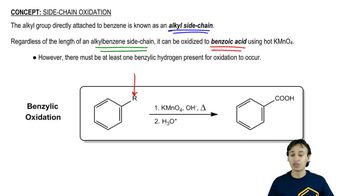
Benzylic Oxidation

Synthesis of Alcohols

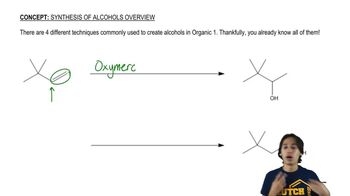
The synthesis of alcohols often involves the addition of nucleophiles to electrophiles. In this case, the nucleophilic Grignard reagent adds to the electrophilic carbon of the ethylene oxide, resulting in the formation of a new carbon-carbon bond. This process is fundamental in organic chemistry, as it allows for the construction of complex molecules and the introduction of functional groups, such as hydroxyl groups in alcohols.
Video consigliato:
02:26
Forming alcohols through Oxymercuration-Reduction.
Pratica correlata
Domanda del libro di testo

Show how you would synthesize the following alcohol by adding Grignard reagents to ethylene oxide.

(c)

609
views

Domanda del libro di testo

Show how you would synthesize the following compound from alkyl halides, vinyl halides, and aryl halides containing no more than six carbon atoms.

(a) octane

1128
views
Domanda del libro di testo

A formate ester, such as ethyl formate, reacts with an excess of a Grignard reagent to give (after protonation) secondary alcohols with two identical alkyl groups.

(a) Propose a mechanism to show how the reaction of ethyl formate with an excess of allylmagnesium bromide gives, after protonation, hepta-1,6-dien-4-ol.

2089
views
Domanda del libro di testo

Show how you would add Grignard reagent to acid chloride or ester to synthesize the following alcohols.

c. dicyclohexylphenylmethanol

612
views
Domanda del libro di testo

Acetylide ions also add to ethylene oxide much like Grignard and organolithium reagents. Predict the products obtained by adding the following acetylide ions to ethylene oxide, followed by a dilute acid workup.

(a) HC≡C:–

(b) CH3CH2–C≡C:–

1360
views
Domanda del libro di testo

A formate ester, such as ethyl formate, reacts with an excess of a Grignard reagent to give (after protonation) secondary alcohols with two identical alkyl groups.

(b) Show how you would use reactions of Grignard reagents with ethyl formate to synthesize the following secondary alcohols.

(i) pentan-3-ol

(ii) diphenylmethanol

(iii) trans,trans-nona-2,7-dien-5-ol

2291
views