Ch.11 - Reactions of Alcohols
Wade - Organic Chemistry 9th Edition
Wade9th EditionOrganic ChemistryISBN: 9780135213728Non è quello che usi tu?Cambia libro di testo
Capitolo 11, Problema 38e

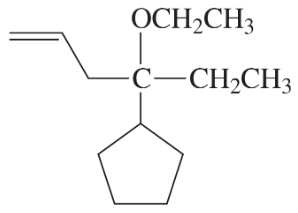
Develop syntheses for the following compounds. As starting materials, you may use cyclopentanol, alcohols containing no more than four carbon atoms, and any common reagents and solvents.
(e)

Guida verificata passo dopo passo
1
Step 1: Analyze the target molecule. The compound contains a cyclopentane ring, an ether functional group (-OCH2CH3), and an alkene group (CH2=CH-). The molecule also has branching with ethyl groups attached to the central carbon.
Step 2: Start with cyclopentanol as the base structure. Convert cyclopentanol to cyclopentyl bromide using PBr3 (phosphorus tribromide) to introduce a good leaving group for subsequent reactions.
Step 3: Perform a Grignard reaction. React cyclopentyl bromide with ethyl magnesium bromide (EtMgBr) to form a cyclopentyl ethyl Grignard reagent. This will allow the introduction of the ethyl group to the central carbon.
Step 4: Introduce the ether functional group. React the intermediate with ethyl bromide (EtBr) in the presence of a strong base like NaH to form the ether (-OCH2CH3) group on the central carbon.
Step 5: Add the alkene group. Use a Wittig reaction or an elimination reaction to introduce the CH2=CH- group at the appropriate position. For example, react the intermediate with a phosphonium ylide or use a strong base to eliminate a leaving group and form the double bond.

Risposta video verificata per un problema simile:

Questa soluzione video è stata consigliata dai nostri tutor come utile per risolvere questo problema.
Durata del video:
5m

Concetti chiave

Ecco i concetti essenziali che devi comprendere per rispondere correttamente alla domanda.

Synthesis of Organic Compounds

Organic synthesis involves the construction of complex organic molecules from simpler ones. This process often requires a series of chemical reactions, utilizing various reagents and conditions to achieve the desired product. Understanding the reactivity of functional groups and the mechanisms of reactions is crucial for designing effective synthetic pathways.
Video consigliato:
01:40
Defining meso compounds.

Reactivity of Alcohols

Alcohols are versatile compounds in organic chemistry, often serving as starting materials for various reactions. They can undergo transformations such as dehydration, oxidation, and substitution, depending on their structure and the reagents used. Recognizing the functional groups and their reactivity patterns is essential for planning syntheses involving alcohols.
Video consigliato:
01:01
How to name alcohols

Organometallic Chemistry

Organometallic compounds contain carbon-metal bonds and are pivotal in organic synthesis. They can act as nucleophiles, facilitating the formation of carbon-carbon bonds through reactions like Grignard or organolithium reactions. Understanding the properties and reactivity of these compounds is vital for constructing complex organic molecules, especially when working with cyclic structures like cyclopentane.
Video consigliato:
02:50
Ruining Organometallics