Ch.11 - Reactions of Alcohols
Wade - Organic Chemistry 9th Edition
Wade9th EditionOrganic ChemistryISBN: 9780135213728Non è quello che usi tu?Cambia libro di testo
Capitolo 11, Problema 43a,b,c

Predict the major products of dehydration catalyzed by sulfuric acid.
(a) hexan-1-ol
(b) hexan-2-ol
(c) pentan-3-ol

Guida verificata passo dopo passo
1
Step 1: Understand the dehydration reaction. Dehydration of alcohols involves the removal of a water molecule, typically catalyzed by an acid like sulfuric acid. The reaction proceeds via the formation of a carbocation intermediate, and the major product is determined by the stability of the carbocation and the Zaitsev rule (favoring the more substituted alkene).
Step 2: Analyze hexan-1-ol (structure B). Hexan-1-ol is a primary alcohol. Upon dehydration, it forms a carbocation at the first carbon, which is unstable. Rearrangement does not occur, and the major product will be the least substituted alkene, 1-hexene.
Step 3: Analyze hexan-2-ol (structure C). Hexan-2-ol is a secondary alcohol. Upon dehydration, it forms a carbocation at the second carbon. This carbocation is relatively stable, and the major product will be the more substituted alkene, 2-hexene, following the Zaitsev rule.
Step 4: Analyze pentan-3-ol (structure A). Pentan-3-ol is a secondary alcohol. Upon dehydration, it forms a carbocation at the third carbon. This carbocation is stable, and the major product will be the more substituted alkene, 3-pentene, following the Zaitsev rule.
Step 5: Summarize the major products. For hexan-1-ol, the major product is 1-hexene. For hexan-2-ol, the major product is 2-hexene. For pentan-3-ol, the major product is 3-pentene. These products are formed based on carbocation stability and the Zaitsev rule.

Risposta video verificata per un problema simile:

Questa soluzione video è stata consigliata dai nostri tutor come utile per risolvere questo problema.
Durata del video:
8m

Concetti chiave

Ecco i concetti essenziali che devi comprendere per rispondere correttamente alla domanda.

Dehydration Reaction

A dehydration reaction involves the removal of a water molecule from an alcohol to form an alkene. This process typically requires an acid catalyst, such as sulfuric acid, which protonates the alcohol, making it a better leaving group. The resulting carbocation can then undergo elimination to form a double bond, leading to the formation of alkenes as major products.
Video consigliato:
01:23
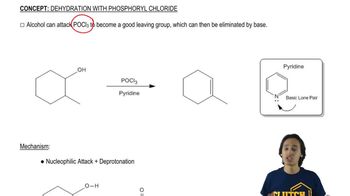
General Reaction of Dehydration with POCl3

Carbocation Stability

The stability of carbocations is crucial in determining the major products of dehydration reactions. Tertiary carbocations are more stable than secondary, which are more stable than primary. The formation of the most stable carbocation intermediate during the reaction pathway will favor the formation of the corresponding alkene, influencing the product distribution.
Video consigliato:
05:58
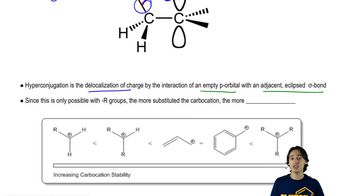
Determining Carbocation Stability

Markovnikov's Rule

Markovnikov's Rule states that in the addition of HX to an alkene, the hydrogen atom will attach to the carbon with the greater number of hydrogen atoms already attached. This principle also applies to dehydration reactions, where the more substituted alkene is typically the major product due to the stability of the carbocation formed during the reaction.
Video consigliato:
03:54
The 18 and 16 Electron Rule