Ch.11 - Reactions of Alcohols
Wade - Organic Chemistry 9th Edition
Wade9th EditionOrganic ChemistryISBN: 9780135213728Non è quello che usi tu?Cambia libro di testo
Capitolo 11, Problema 28

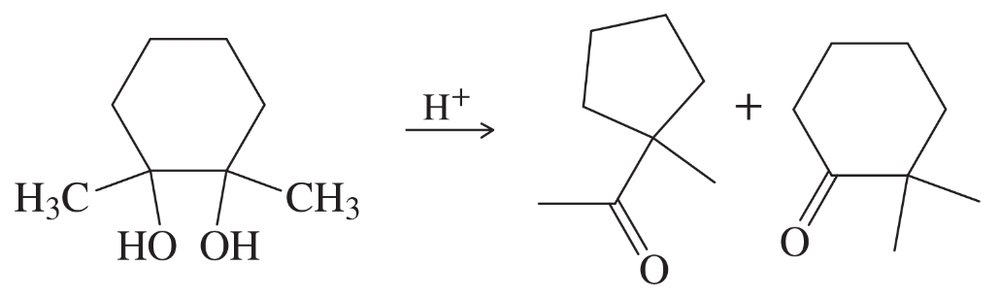
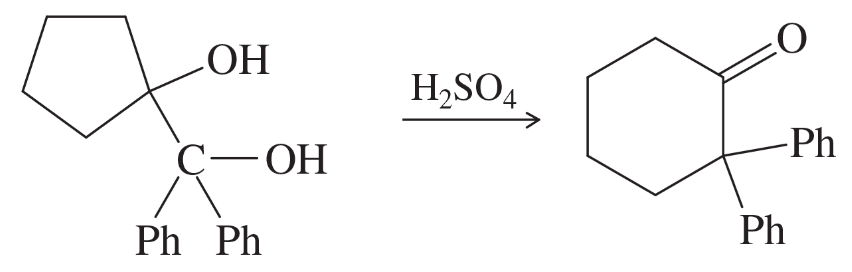
Propose a mechanism for each reaction.
(a)
(b)

Guida verificata passo dopo passo
1
Step 1 (Reaction A): Protonation of one of the hydroxyl groups occurs in the presence of H⁺, making it a better leaving group. This forms a carbocation intermediate.
Step 2 (Reaction A): The carbocation undergoes rearrangement to stabilize itself, potentially forming a more stable tertiary carbocation.
Step 3 (Reaction A): The remaining hydroxyl group acts as a nucleophile and attacks the carbocation, leading to the formation of a cyclic intermediate.
Step 4 (Reaction A): Deprotonation of the cyclic intermediate occurs, resulting in the formation of the ketone product.
Step 5 (Reaction B): In the presence of H₂SO₄, the hydroxyl group is protonated, making it a better leaving group. This leads to the formation of a carbocation intermediate, which undergoes rearrangement and nucleophilic attack by the phenyl groups to form the ketone product.

Risposta video verificata per un problema simile:

Questa soluzione video è stata consigliata dai nostri tutor come utile per risolvere questo problema.
Durata del video:
17m

Concetti chiave

Ecco i concetti essenziali che devi comprendere per rispondere correttamente alla domanda.

Protonation

Protonation is the addition of a proton (H+) to a molecule, which can enhance its reactivity. In the context of organic reactions, protonation often occurs at sites of high electron density, such as alcohols or double bonds, making them more susceptible to nucleophilic attack or facilitating bond rearrangements.
Video consigliato:
03:
Proton Splitting

Nucleophilic Attack

Nucleophilic attack refers to the process where a nucleophile, an electron-rich species, attacks an electrophile, an electron-deficient species. This is a fundamental step in many organic reactions, leading to the formation of new bonds. Understanding the nature of nucleophiles and electrophiles is crucial for predicting reaction outcomes.
Video consigliato:
08:27
Nucleophilic Addition

Rearrangement Reactions

Rearrangement reactions involve the reorganization of atoms within a molecule, often resulting in structural isomers. These reactions can be driven by the stability of intermediates formed during the process, such as carbocations. Recognizing the conditions that favor rearrangements is essential for proposing accurate reaction mechanisms.
Video consigliato:
06:28
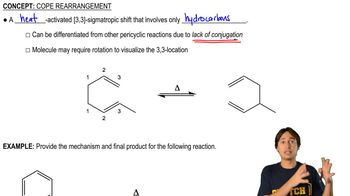
Definition of Cope Rearrangement