Ch.11 - Reactions of Alcohols
Wade - Organic Chemistry 9th Edition
Wade9th EditionOrganic ChemistryISBN: 9780135213728Non è quello che usi tu?Cambia libro di testo
Capitolo 11, Problema 56a,b,c

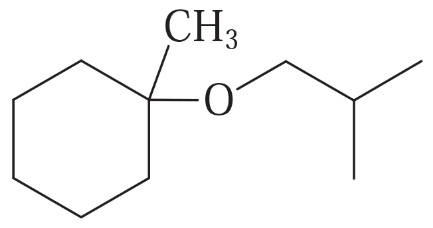
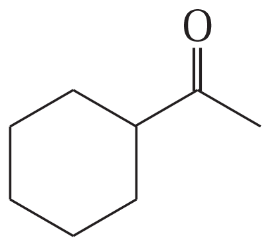
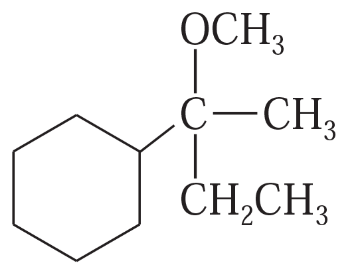
Show how you would synthesize the following compounds. As starting materials, you may use any alcohols containing four or fewer carbon atoms, cyclohexanol, and any necessary solvents and inorganic reagents.
(a)
(b)
(c)

Guida verificata passo dopo passo
1
Step 1: For compound (a), start with cyclohexanol as the base alcohol. Perform a Williamson ether synthesis by reacting cyclohexanol with an alkyl halide (e.g., 2-bromopropane) in the presence of a strong base like NaH or KOH. This will form the ether bond between cyclohexanol and the alkyl group.
Step 2: For compound (b), begin with cyclohexanol and oxidize it to cyclohexanone using an oxidizing agent such as PCC (Pyridinium Chlorochromate) or Jones reagent (CrO3/H2SO4). This converts the alcohol group into a ketone group.
Step 3: For compound (c), start with cyclohexanol and perform a Grignard reaction. First, prepare the Grignard reagent by reacting an alkyl halide (e.g., ethyl bromide) with magnesium in dry ether. Then, react the Grignard reagent with cyclohexanone to form the tertiary alcohol intermediate.
Step 4: To complete compound (c), methylate the tertiary alcohol using a methylating agent such as dimethyl sulfate or methyl iodide in the presence of a base like NaOH. This introduces the methoxy group (-OCH3) to the molecule.
Step 5: Ensure proper purification and isolation of the synthesized compounds using techniques like distillation or recrystallization, depending on the physical properties of the final products.

Risposta video verificata per un problema simile:

Questa soluzione video è stata consigliata dai nostri tutor come utile per risolvere questo problema.
Durata del video:
13m

Concetti chiave

Ecco i concetti essenziali che devi comprendere per rispondere correttamente alla domanda.

Alcohols and Their Reactivity

Alcohols are organic compounds containing one or more hydroxyl (-OH) groups. Their reactivity is influenced by the structure of the alcohol, including the number of carbon atoms and the presence of functional groups. Understanding how alcohols can undergo reactions such as dehydration, oxidation, or substitution is crucial for synthesizing various organic compounds.
Video consigliato:
01:01
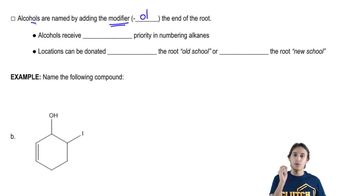
How to name alcohols

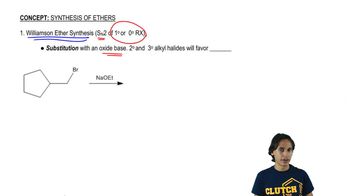
Synthesis of Ethers

Ethers are compounds characterized by an oxygen atom connected to two alkyl or aryl groups. They can be synthesized through the dehydration of alcohols, where two alcohol molecules react to form an ether and water. Familiarity with the mechanisms of ether formation, including the use of acid catalysts, is essential for successfully synthesizing ethers from the provided starting materials.
Video consigliato:
03:50
The Mechanism of Williamson Ether Synthesis.

Cyclohexanol and Its Derivatives

Cyclohexanol is a six-carbon cyclic alcohol that can be transformed into various derivatives through reactions such as oxidation, dehydration, or substitution. Understanding the reactivity of cyclohexanol, including how it can be converted into ketones or ethers, is important for planning synthetic routes to the target compounds shown in the question.
Video consigliato:
02:49
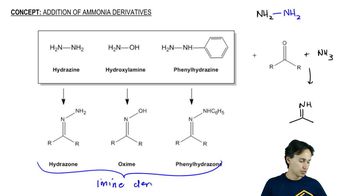
Ammonia Derivatives