Ch.11 - Reactions of Alcohols
Wade - Organic Chemistry 9th Edition
Wade9th EditionOrganic ChemistryISBN: 9780135213728Non è quello che usi tu?Cambia libro di testo
Capitolo 11, Problema 37a

To practice working through the early parts of a multistep synthesis, devise syntheses of
(a) pentan-3-one from alcohols containing no more than three carbon atoms.

Guida verificata passo dopo passo
1
Step 1: Identify the target molecule, pentan-3-one, which is a ketone with the carbonyl group on the third carbon of a five-carbon chain. This will guide the synthesis strategy.
Step 2: Recognize the constraint that the starting materials must be alcohols containing no more than three carbon atoms. This means you need to build the five-carbon chain using smaller alcohols.
Step 3: Select appropriate alcohols as starting materials. For example, ethanol (CH₃CH₂OH) and propanol (CH₃CH₂CH₂OH) are suitable candidates because they each contain fewer than three carbons.
Step 4: Devise a strategy to combine the alcohols into a five-carbon chain. This can involve converting the alcohols into reactive intermediates, such as alkyl halides, followed by a coupling reaction like the Grignard reaction or an alkylation reaction.
Step 5: Once the five-carbon chain is formed, oxidize the alcohol group on the third carbon to a ketone using an oxidizing agent such as PCC (pyridinium chlorochromate) or Jones reagent. Ensure the reaction conditions are controlled to avoid overoxidation.

Risposta video verificata per un problema simile:

Questa soluzione video è stata consigliata dai nostri tutor come utile per risolvere questo problema.
Durata del video:
7m

Concetti chiave

Ecco i concetti essenziali che devi comprendere per rispondere correttamente alla domanda.

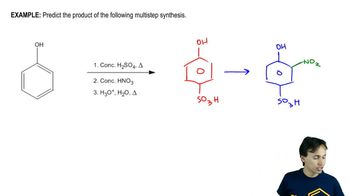
Multistep Synthesis

Multistep synthesis involves a series of chemical reactions that transform starting materials into a desired product through intermediate compounds. Understanding this concept is crucial for planning the sequence of reactions needed to convert simple alcohols into more complex molecules like pentan-3-one. Each step must be carefully designed to ensure that the desired functional groups are introduced and that the overall yield is maximized.
Video consigliato:
02:15
Multistep Synthesis

Functional Group Transformation

Functional group transformation refers to the process of converting one functional group into another during a chemical reaction. In the context of synthesizing pentan-3-one, it is essential to know how to manipulate alcohols, which contain hydroxyl (-OH) groups, into ketones, which have a carbonyl (C=O) group. This transformation often requires specific reagents and conditions to achieve the desired outcome.
Video consigliato:
02:36
Identifying Functional Groups

Carbon Skeleton Rearrangement

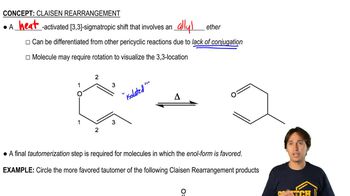
Carbon skeleton rearrangement is a key concept in organic chemistry that involves the reorganization of the carbon framework of a molecule during a reaction. When synthesizing pentan-3-one from smaller alcohols, understanding how to effectively rearrange carbon chains is vital. This may involve reactions such as dehydration or oxidation, which can alter the position of functional groups and the overall structure of the molecule.
Video consigliato:
06:08
Definition of Claisen Rearrangement
Pratica correlata
Domanda del libro di testo

To practice working through the early parts of a multistep synthesis, devise syntheses of

(b) 3-ethylpentan-2-one from compounds containing no more than three carbon atoms.

1124
views

Domanda del libro di testo

Develop syntheses for the following compounds. As starting materials, you may use cyclopentanol, alcohols containing no more than four carbon atoms, and any common reagents and solvents.

(b) 1-chloro-1-ethylcyclopentane

1055
views
Domanda del libro di testo

A student wanted to use the Williamson ether synthesis to make (R)-2-ethoxybutane. He remembered that the Williamson synthesis involves an SN2 displacement, which takes place with inversion of configuration. He ordered a bottle of (S)-butan-2-ol for his chiral starting material. He also remembered that the SN2 goes best on primary halides and tosylates, so he made ethyl tosylate and sodium (S)-but-2-oxide. After warming these reagents together, he obtained an excellent yield of 2-ethoxybutane.

a. What enantiomer of 2-ethoxybutane did he obtain? Explain how this enantiomer results from the SN2 reaction of ethyl tosylate with sodium (S)-but-2-oxide.

b. What would have been the best synthesis of (R)-2-ethoxybutane?

c. How can this student convert the rest of his bottle of (S)-butan-2-ol to (R)-2-ethoxybutane?

966
views
Domanda del libro di testo

(a) Show how ethanol and cyclohexanol may be used to synthesize cyclohexyl ethyl ether (tosylation followed by the Williamson ether synthesis).

(b) Why can't we synthesize this product simply by mixing the two alcohols, adding some sulfuric acid, and heating?

1632
views
Domanda del libro di testo

Phenols (pKa ≈ 10) are more acidic than other alcohols, so they are easily deprotonated by sodium hydroxide or potassium hydroxide. The anions of phenols (phenoxide ions) can be used in the Williamson ether synthesis, especially with very reactive alkylating reagents such as dimethyl sulfate. Using phenol, dimethyl sulfate, and other necessary reagents, show how you would synthesize methyl phenyl ether.

1485
views
Domanda del libro di testo

Develop syntheses for the following compounds. As starting materials, you may use cyclopentanol, alcohols containing no more than four carbon atoms, and any common reagents and solvents.

(a) trans-cyclopentane-1,2-diol

1045
views