
Ch.11 - Reactions of Alcohols
Wade - Organic Chemistry 9th Edition
Wade9th EditionOrganic ChemistryISBN: 9780135213728Non è quello che usi tu?Cambia libro di testo
Capitolo 11, Problema 66c,d

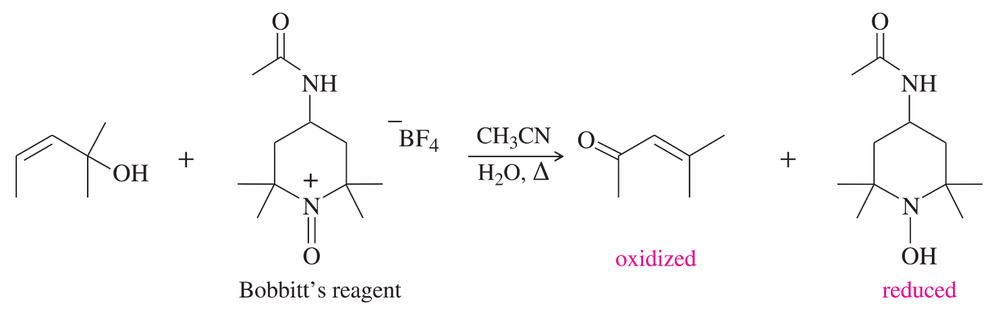
Under normal circumstances, tertiary alcohols are not oxidized. However, when the tertiary alcohol is allylic, it can undergo a migration of the double bond (called an allylic shift) and subsequent oxidation of the alcohol. A particularly effective reagent for this reaction is Bobbitt's reagent, similar to TEMPO used in many oxidations. (M. Shibuya et al., J. Org. Chem., 2008, 73, 4750.)

Show the expected product when each of these 3° allylic alcohols is oxidized by Bobbitt’s reagent
(c)
(d) Chemical structure of a tertiary allylic alcohol with a hydroxyl group and phenyl group, illustrating oxidation by Bobbitt's reagent.

Guida verificata passo dopo passo
1
Step 1: Recognize that the tertiary alcohols in the given structures are allylic, meaning they are adjacent to a double bond. This allows for an allylic shift of the double bond during the oxidation process.
Step 2: Understand the role of Bobbitt’s reagent in the reaction. Bobbitt’s reagent facilitates the oxidation of the allylic alcohol by first enabling the migration of the double bond (allylic shift) and then converting the alcohol group into a carbonyl group.
Step 3: For structure (c), identify the allylic alcohol group and predict the allylic shift of the double bond. After the shift, the alcohol group is oxidized to a ketone or aldehyde, depending on the structure.
Step 4: For structure (d), locate the allylic alcohol group and analyze the possible allylic shift of the double bond. Following the shift, the alcohol group is oxidized to a carbonyl group, likely forming a ketone due to the tertiary nature of the alcohol.
Step 5: Draw the expected products for both (c) and (d), ensuring the double bond has shifted appropriately and the alcohol group has been oxidized to a carbonyl group. Verify that the stereochemistry and connectivity of the molecules are preserved during the reaction.

Risposta video verificata per un problema simile:

Questa soluzione video è stata consigliata dai nostri tutor come utile per risolvere questo problema.
Durata del video:
4m

Concetti chiave

Ecco i concetti essenziali che devi comprendere per rispondere correttamente alla domanda.

Tertiary Alcohols

Tertiary alcohols are organic compounds where the hydroxyl (-OH) group is attached to a carbon atom that is connected to three other carbon atoms. This structure makes them relatively stable and less reactive towards oxidation compared to primary and secondary alcohols. Understanding the unique properties of tertiary alcohols is crucial for predicting their behavior in chemical reactions, particularly in oxidation processes.
Video consigliato:
Percorso guidato
2:07
Tertiary Protein Structure Concept 1

Allylic Shift

An allylic shift is a rearrangement that occurs in allylic systems, where a double bond migrates to a neighboring position. This process is significant in the context of allylic alcohols, as it allows for the formation of more stable intermediates that can be further oxidized. Recognizing how this shift influences the reaction pathway is essential for predicting the products of reactions involving allylic alcohols.
Video consigliato:
00:48
The products of Allylic Chlorination.

Bobbitt’s Reagent

Bobbitt’s reagent is a specific oxidizing agent used in organic chemistry, known for its effectiveness in oxidizing alcohols, particularly tertiary and allylic alcohols. It functions similarly to TEMPO, facilitating the conversion of alcohols to carbonyl compounds while minimizing side reactions. Familiarity with this reagent and its mechanism of action is important for understanding the oxidation of allylic tertiary alcohols in the given context.
Video consigliato:
01:52
Reagents