
Ch.11 - Reactions of Alcohols
Wade - Organic Chemistry 9th Edition
Wade9th EditionOrganic ChemistryISBN: 9780135213728Non è quello che usi tu?Cambia libro di testo
Capitolo 11, Problema 32

Use resonance forms of the conjugate bases to explain why methanesulfonic acid (CH3SO3H, pKa = –2.6) is a much stronger acid than acetic acid (CH3COOH, pKa = 4.8).

Guida verificata passo dopo passo
1
Identify the conjugate bases of methanesulfonic acid (CH3SO3H) and acetic acid (CH3COOH). The conjugate base of methanesulfonic acid is the methanesulfonate ion (CH3SO3⁻), and the conjugate base of acetic acid is the acetate ion (CH3COO⁻).
Recall that the stability of the conjugate base is a key factor in determining the strength of an acid. A more stable conjugate base corresponds to a stronger acid because the equilibrium of the acid dissociation reaction shifts more toward the ionized form.
Analyze the resonance structures of the methanesulfonate ion (CH3SO3⁻). The negative charge on the oxygen atom is delocalized over three oxygen atoms through resonance, which significantly stabilizes the conjugate base. Write the resonance forms of CH3SO3⁻ using MathML: CH3(SO3)-.
Compare this to the resonance structures of the acetate ion (CH3COO⁻). The negative charge on the oxygen atom is delocalized over only two oxygen atoms, which provides less stabilization compared to the methanesulfonate ion. Write the resonance forms of CH3COO⁻ using MathML: CH3(CO2)-.
Conclude that the greater resonance stabilization of the methanesulfonate ion (CH3SO3⁻) compared to the acetate ion (CH3COO⁻) makes methanesulfonic acid (CH3SO3H) a much stronger acid than acetic acid (CH3COOH). This is reflected in their respective pKa values, where a lower pKa indicates a stronger acid.

Risposta video verificata per un problema simile:

Questa soluzione video è stata consigliata dai nostri tutor come utile per risolvere questo problema.
Durata del video:
4m

Concetti chiave

Ecco i concetti essenziali che devi comprendere per rispondere correttamente alla domanda.

Resonance Structures

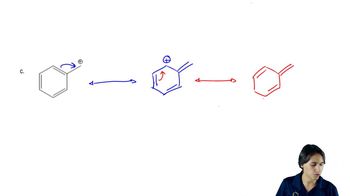
Resonance structures are different ways of drawing the same molecule that illustrate the delocalization of electrons. In the context of acids, resonance can stabilize the conjugate base by distributing negative charge over multiple atoms, making the acid stronger. For methanesulfonic acid, its conjugate base can be represented by several resonance forms, enhancing stability compared to the conjugate base of acetic acid.
Video consigliato:
03:04
Drawing Resonance Structures

Acid Strength and pKa

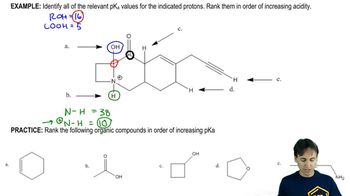
The strength of an acid is often measured by its pKa value, which indicates the tendency of the acid to donate a proton (H+). A lower pKa value signifies a stronger acid, as it more readily donates protons. Methanesulfonic acid has a pKa of -2.6, indicating it is a much stronger acid than acetic acid, which has a pKa of 4.8, reflecting its weaker tendency to lose a proton.
Video consigliato:
07:45
Identifying pKa values

Conjugate Bases

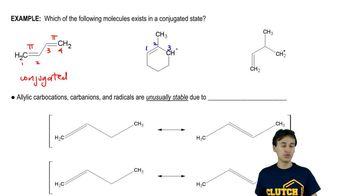
The conjugate base of an acid is what remains after the acid donates a proton. The stability of the conjugate base is crucial in determining the strength of the corresponding acid. In this case, the conjugate base of methanesulfonic acid is more stable due to resonance stabilization, while the conjugate base of acetic acid is less stable, contributing to the significant difference in their acid strengths.
Video consigliato:
03:27
Conjugated states
Pratica correlata
Domanda del libro di testo

A student wanted to use the Williamson ether synthesis to make (R)-2-ethoxybutane. He remembered that the Williamson synthesis involves an SN2 displacement, which takes place with inversion of configuration. He ordered a bottle of (S)-butan-2-ol for his chiral starting material. He also remembered that the SN2 goes best on primary halides and tosylates, so he made ethyl tosylate and sodium (S)-but-2-oxide. After warming these reagents together, he obtained an excellent yield of 2-ethoxybutane.

a. What enantiomer of 2-ethoxybutane did he obtain? Explain how this enantiomer results from the SN2 reaction of ethyl tosylate with sodium (S)-but-2-oxide.

b. What would have been the best synthesis of (R)-2-ethoxybutane?

c. How can this student convert the rest of his bottle of (S)-butan-2-ol to (R)-2-ethoxybutane?

966
views
Domanda del libro di testo

A good Williamson synthesis of ethyl methyl ether would be

What is wrong with the following proposed synthesis of ethyl methyl ether? First, ethanol is treated with acid to protonate the hydroxy group (making it a good leaving group), and then sodium methoxide is added to displace water.

1376
views
1
rank
Domanda del libro di testo

(a) Show how ethanol and cyclohexanol may be used to synthesize cyclohexyl ethyl ether (tosylation followed by the Williamson ether synthesis).

(b) Why can't we synthesize this product simply by mixing the two alcohols, adding some sulfuric acid, and heating?

1632
views
Domanda del libro di testo

Show the alcohol and the acid chloride that combine to make the following esters.

(c)

(d)

725
views
Domanda del libro di testo

Predict the products formed by periodic acid cleavage of the following diols.

(a) CH3CH(OH)CH(OH)CH3

(b)

1682
views
Domanda del libro di testo

Predict the products formed by periodic acid cleavage of the following diols.

(c)

(d)

969
views