


Ch. 12 - Infrared Spectroscopy and Mass Spectrometry
Wade - Organic Chemistry 9th Edition
Wade9th EditionOrganic ChemistryISBN: 9780135213728Non è quello che usi tu?Cambia libro di testo
Capitolo 12, Problema 30

These five structures all have distinguishing absorptions in the IR. Match each structure with its characteristic absorption.

(a) sharp, 2254 cm–1
(b) very broad, centered about 3330 cm–1
(c) strong, slightly broadened, 1645 cm–1
(d) broad with spikes at 3367 and 3292 cm–1
(e) strong, sharp 1717 cm–1

Guida verificata passo dopo passo
1
Step 1: Analyze the IR absorption data provided in the problem. Each absorption corresponds to a specific functional group or bond type. For example: (a) sharp, 2254 cm⁻¹ indicates a nitrile group (-C≡N), (b) very broad, centered about 3330 cm⁻¹ indicates an alcohol (-OH), (c) strong, slightly broadened, 1645 cm⁻¹ indicates a C=C bond, (d) broad with spikes at 3367 and 3292 cm⁻¹ indicates a primary amine (-NH₂), and (e) strong, sharp 1717 cm⁻¹ indicates a carbonyl group (C=O).
Step 2: Examine the chemical structures provided in the images. Identify the functional groups present in each structure. For example: Structure 1 contains an alcohol (-OH), Structure 2 contains a ketone (C=O), Structure 3 contains a primary amine (-NH₂), Structure 4 contains a nitrile (-C≡N), and Structure 5 contains an amide (C=O and -NH).
Step 3: Match the IR absorption data to the corresponding functional groups in the structures. For example: (a) sharp, 2254 cm⁻¹ matches the nitrile group in Structure 4, (b) very broad, centered about 3330 cm⁻¹ matches the alcohol group in Structure 1, (c) strong, slightly broadened, 1645 cm⁻¹ matches the C=C bond (not present in these structures, so this may be irrelevant), (d) broad with spikes at 3367 and 3292 cm⁻¹ matches the primary amine group in Structure 3, and (e) strong, sharp 1717 cm⁻¹ matches the carbonyl group in Structure 2.
Step 4: Confirm the matches by considering the characteristic IR absorption ranges for each functional group. For example: Nitrile groups typically absorb around 2200-2260 cm⁻¹, alcohols around 3200-3600 cm⁻¹ (broad), primary amines around 3300-3500 cm⁻¹ (with spikes), and carbonyl groups around 1700-1750 cm⁻¹.
Step 5: Finalize the assignments of the IR absorptions to the structures based on the analysis. Ensure that each absorption is uniquely matched to the correct structure and functional group.

Risposta video verificata per un problema simile:

Questa soluzione video è stata consigliata dai nostri tutor come utile per risolvere questo problema.
Durata del video:
4m

Concetti chiave

Ecco i concetti essenziali che devi comprendere per rispondere correttamente alla domanda.

Infrared Spectroscopy (IR)

Infrared spectroscopy is a technique used to identify functional groups in organic compounds by measuring the absorption of infrared light at specific wavelengths. Each functional group has characteristic absorption bands, which appear as peaks in an IR spectrum. Understanding these absorptions helps in determining the structure of organic molecules.
Video consigliato:
16:04
General Features of IR Spect

Functional Groups

Functional groups are specific groups of atoms within molecules that are responsible for the characteristic chemical reactions of those molecules. Common functional groups include hydroxyl (-OH), carbonyl (C=O), and amine (-NH2). Identifying these groups is crucial for predicting the IR absorption patterns associated with different organic compounds.
Video consigliato:
02:36
Identifying Functional Groups

Wavenumber and Absorption Peaks

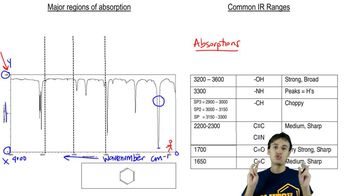
Wavenumber, measured in cm⁻¹, is the reciprocal of the wavelength and is commonly used in IR spectroscopy to describe the position of absorption peaks. Each peak corresponds to a specific vibrational transition of molecular bonds. For example, a sharp peak around 2254 cm⁻¹ typically indicates a nitrile group (C≡N), while broad peaks around 3300 cm⁻¹ suggest the presence of O-H or N-H bonds.
Video consigliato:
09:26
The (M + 1) Peak
Pratica correlata
Domanda del libro di testo

The ultimate test of fluency in MS and IR is whether you can determine a moderately complex structure from just the MS and the IR, with no additional information. The IR and MS of a compound are shown below. Use everything you know about IR and MS, plus reasoning and intuition, to determine a likely structure. Then show how your proposed structure is consistent with these spectra.

<IMAGES>

1237
views
Domanda del libro di testo

Three common lab experiments are shown. In each case, describe how the IR spectrum of the product would differ from that of the reactant. Give approximate frequencies for distinctive peaks in the IR spectrum of the reactant and also that of the product.

1349
views
Domanda del libro di testo

Consider the following four structures, followed by mass spectral data. Match each structure with its characteristic molecular ion or fragment. In each case, give a likely structure of the ion responsible for the base peak.

(a) base peak at 105

(b) base peak at 72

(c) M+ doublet at 198 and 200, base peak at 91

(d) base peak at 91, large peak at 43

1466
views
Domanda del libro di testo

A laboratory student added 1-bromobutane to a flask containing dry ether and magnesium turnings. An exothermic reaction resulted, and the ether boiled vigorously for several minutes. Then she added acetone to the reaction mixture and the ether boiled even more vigorously. She added dilute acid to the mixture and separated the layers. She evaporated the ether layer, and distilled a liquid that boiled at 143 °C. GC–MS analysis of the distillate showed one major product with a few minor impurities. The mass spectrum of the major product is shown here.

(b) Explain why the molecular ion is or is not visible in the mass spectrum, and show what ions are likely to be responsible for the strong peaks at m/z 59 and 101.

<IMAGE>

1399
views