Ch. 14 - Ethers, Epoxides, and Thioethers
Wade - Organic Chemistry 9th Edition
Wade9th EditionOrganic ChemistryISBN: 9780135213728Non è quello che usi tu?Cambia libro di testo
Capitolo 14, Problema 16

Boron tribromide (BBr3) cleaves ethers to give alkyl halides and alcohols.

The reaction is thought to involve attack by a bromide ion on the Lewis acid–base adduct of the ether with BBr3 (a strong Lewis acid). Propose a mechanism for the reaction of butyl methyl ether with BBr3 to give (after hydrolysis) butan-1-ol and bromomethane.

Guida verificata passo dopo passo
1
Step 1: Recognize the role of BBr3 as a strong Lewis acid. It interacts with the ether oxygen atom, which has lone pairs of electrons, forming a Lewis acid-base adduct. This interaction increases the electrophilicity of the ether oxygen, making it more susceptible to nucleophilic attack.
Step 2: Propose the first step of the mechanism. The ether (butyl methyl ether, CH3-O-C4H9) reacts with BBr3 to form a Lewis acid-base adduct. This can be represented as CH3-O-C4H9 + BBr3 → CH3-O-BBr2-C4H9. The oxygen atom donates a lone pair to the boron atom, forming a coordinate covalent bond.
Step 3: Introduce the nucleophilic attack by bromide ion (Br⁻). The bromide ion attacks the carbon atom of the methyl group (CH3) in the ether, leading to cleavage of the C-O bond. This results in the formation of bromomethane (CH3Br) and a butoxyboron intermediate (C4H9-O-BBr2).
Step 4: Describe the hydrolysis step. The butoxyboron intermediate (C4H9-O-BBr2) undergoes hydrolysis in the presence of water. This reaction produces butan-1-ol (C4H9OH), boric acid (B(OH)3), and hydrogen bromide (HBr).
Step 5: Summarize the overall reaction. The mechanism involves the formation of a Lewis acid-base adduct, nucleophilic attack by bromide ion, cleavage of the ether bond, and subsequent hydrolysis to yield the final products: butan-1-ol (C4H9OH) and bromomethane (CH3Br).

Risposta video verificata per un problema simile:

Questa soluzione video è stata consigliata dai nostri tutor come utile per risolvere questo problema.
Durata del video:
4m

Concetti chiave

Ecco i concetti essenziali che devi comprendere per rispondere correttamente alla domanda.

Lewis Acids and Bases

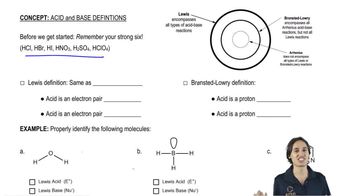
Lewis acids are substances that can accept an electron pair, while Lewis bases are those that can donate an electron pair. In the context of the reaction with BBr3, the ether acts as a Lewis base, forming a complex with the Lewis acid BBr3. This interaction is crucial for the subsequent steps of the reaction, as it facilitates the cleavage of the ether bond.
Video consigliato:
02:49
The Lewis definition of acids and bases.

Ethers and Their Cleavage

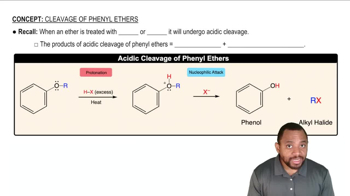
Ethers are organic compounds characterized by an oxygen atom bonded to two alkyl or aryl groups. The cleavage of ethers typically involves breaking the C-O bond, which can be achieved through various reagents, including strong Lewis acids like BBr3. Understanding the mechanism of ether cleavage is essential for predicting the products formed in the reaction.
Video consigliato:
Percorso guidato
1:45
Cleavage of Phenyl Ethers Concept 1

Nucleophilic Substitution Reactions

Nucleophilic substitution reactions involve the replacement of a leaving group by a nucleophile. In the proposed mechanism, the bromide ion acts as a nucleophile that attacks the carbon atom bonded to the leaving group (the alkyl part of the ether). This step is critical for generating the alkyl halide and alcohol products after hydrolysis.
Video consigliato:
01:47
Nucleophiles and Electrophiles can react in Substitution Reactions.
Pratica correlata
Domanda del libro di testo

Predict the products of the following reactions. An excess of acid is available in each case.

(d)

765
views

Domanda del libro di testo

Predict the products of the following reactions. An excess of acid is available in each case.

(c) anisole (methoxybenzene) + HBr

760
views
Domanda del libro di testo

Show how you would use a protecting group to convert 4-bromobutan-1-ol to hept-5-yn-1-ol.

1196
views
Domanda del libro di testo

Show how you would synthesize butyl isopropyl sulfide using butan-1-ol, propan-2-ol, and any solvents and reagents you need.

1108
views
Domanda del libro di testo

Predict the products of the following reactions. An excess of acid is available in each case.

(a) ethoxycyclohexane + HBr

(b) tetrahydropyran + HI

(c) anisole (methoxybenzene) + HBr

1895
views
1
rank
Domanda del libro di testo

Mustard gas, Cl–CH2CH2–S–CH2CH2–Cl, was used as a poisonous chemical agent in World War I. Mustard gas is much more toxic than a typical primary alkyl chloride. Its toxicity stems from its ability to alkylate amino groups on important metabolic enzymes, rendering the enzymes inactive.

a. Propose a mechanism to explain why mustard gas is an exceptionally potent alkylating agent.

b. Bleach (sodium hypochlorite, NaOCl, a strong oxidizing agent) neutralizes and inactivates mustard gas. Bleach is also effective on organic stains because it oxidizes colored compounds to colorless compounds. Propose products that might be formed by the reaction of mustard gas with bleach.

1173
views