
Ch. 14 - Ethers, Epoxides, and Thioethers
Wade - Organic Chemistry 9th Edition
Wade9th EditionOrganic ChemistryISBN: 9780135213728Non è quello che usi tu?Cambia libro di testo
Capitolo 14, Problema 42

Give the structures of intermediates A through H in the following synthesis of trans-1-cyclohexyl-2-methoxycyclohexane.
Diagram illustrating the synthesis pathway for trans-1-cyclohexyl-2-methoxycyclohexane with labeled intermediates A to H.

Guida verificata passo dopo passo
1
Step 1: Analyze the starting material, cyclohexanol, and the first reaction with H2SO4 and heat. This is an elimination reaction that converts the alcohol into cyclohexene (intermediate A) via dehydration.
Step 2: Intermediate A undergoes a reaction with concentrated HBr and heat. This is an electrophilic addition reaction where HBr adds across the double bond of cyclohexene to form cyclohexyl bromide (intermediate B).
Step 3: Intermediate B reacts with Hg(OAc)2 and CH3OH followed by NaBH4. This is an oxymercuration-demercuration reaction, which adds a methoxy group (-OCH3) to the more substituted carbon of the double bond, forming intermediate F.
Step 4: Intermediate F reacts with mCPBA (meta-chloroperoxybenzoic acid). This is an epoxidation reaction that converts the double bond into an epoxide ring, forming intermediate E.
Step 5: Intermediate E undergoes a reaction with Mg in ether followed by hydrolysis with H3O+. This opens the epoxide ring and forms intermediate G, which is then treated with Na to yield intermediate H, the final product trans-1-cyclohexyl-2-methoxycyclohexane.

Risposta video verificata per un problema simile:

Questa soluzione video è stata consigliata dai nostri tutor come utile per risolvere questo problema.
Durata del video:
2m

Concetti chiave

Ecco i concetti essenziali che devi comprendere per rispondere correttamente alla domanda.

Synthesis Pathways

Understanding synthesis pathways is crucial in organic chemistry as they outline the step-by-step reactions needed to convert starting materials into desired products. Each step often involves specific reagents and conditions that facilitate the transformation of intermediates, which are compounds formed during the reaction sequence. Recognizing these pathways helps in predicting the structure of intermediates and the final product.
Video consigliato:
Percorso guidato
2:13
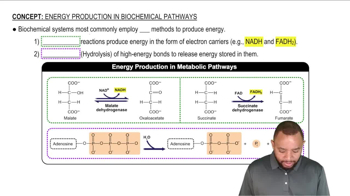
Energy Production In Biochemical Pathways Concept 1

Reagents and Reaction Conditions

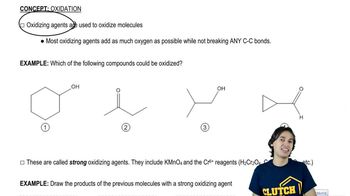
Different reagents and reaction conditions play a vital role in determining the outcome of organic reactions. For instance, the use of concentrated HBr and heat in the synthesis indicates a potential elimination or substitution reaction, while reagents like Hg(OAc)2 and NaBH4 suggest a hydration process. Understanding how these reagents interact with substrates is essential for predicting the structures of intermediates A through H.
Video consigliato:
01:52
Reagents

Mechanisms of Organic Reactions

The mechanisms of organic reactions describe the stepwise process by which reactants are converted into products, including the formation and transformation of intermediates. Knowledge of mechanisms, such as nucleophilic substitution or electrophilic addition, allows chemists to rationalize the formation of specific intermediates and products. This understanding is key to deducing the structures of intermediates A to H in the given synthesis.
Video consigliato:
02:17
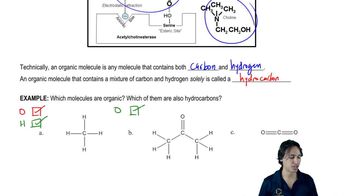
Identifying organic molecules
Pratica correlata
Domanda del libro di testo

Both LiAlH4 and Grignard reagents react with carbonyl compounds to give alkoxide ion intermediates (that become protonated in an aqueous workup). Those alkoxides can react with 1° or methyl alkyl halides or tosylates to give ethers. Show how the following ethers can be formed in this two-step process. As starting materials you may use any reactants containing 7 carbons or fewer.

(b)

614
views
Domanda del libro di testo

Both LiAlH4 and Grignard reagents react with carbonyl compounds to give alkoxide ion intermediates (that become protonated in an aqueous workup). Those alkoxides can react with 1° or methyl alkyl halides or tosylates to give ethers. Show how the following ethers can be formed in this two-step process. As starting materials you may use any reactants containing 7 carbons or fewer.

(a)

762
views
Domanda del libro di testo

Both LiAlH4 and Grignard reagents react with carbonyl compounds to give alkoxide ion intermediates (that become protonated in an aqueous workup). Those alkoxides can react with 1° or methyl alkyl halides or tosylates to give ethers. Show how the following ethers can be formed in this two-step process. As starting materials you may use any reactants containing 7 carbons or fewer.

(c)

506
views
Domanda del libro di testo

Give the structures of the intermediates represented by letters O, P, and Q in this synthesis.

576
views
Domanda del libro di testo

Give the structures of the intermediates represented by letters K and Q in this synthesis.

706
views
Domanda del libro di testo

Give the structures of the intermediates represented by letters J, L, M, and N in this synthesis.

993
views