
Ch. 14 - Ethers, Epoxides, and Thioethers
Wade - Organic Chemistry 9th Edition
Wade9th EditionOrganic ChemistryISBN: 9780135213728Non è quello che usi tu?Cambia libro di testo
Capitolo 14, Problema 26d,e,f

Predict the major product when each reagent reacts with ethylene oxide.
(d) PhNH2 (aniline)
(e) KCN (potassium cyanide)
(f) NaN3 (sodium azide)

Guida verificata passo dopo passo
1
Step 1: Understand the structure and reactivity of ethylene oxide. Ethylene oxide is a three-membered cyclic ether (epoxide) with significant ring strain, making it highly reactive towards nucleophiles. The nucleophile will attack the less sterically hindered carbon of the epoxide, leading to ring opening.
Step 2: Analyze the reagent in part (d), PhNH2 (aniline). Aniline is a nucleophile due to the lone pair on the nitrogen atom. The nitrogen will attack the less hindered carbon of ethylene oxide, opening the ring and forming a β-amino alcohol. The product will have the structure PhNH-CH2-CH2OH.
Step 3: Analyze the reagent in part (e), KCN (potassium cyanide). The cyanide ion (CN⁻) is a strong nucleophile. It will attack the less hindered carbon of ethylene oxide, opening the ring and forming a β-cyano alcohol. The product will have the structure HO-CH2-CH2-CN.
Step 4: Analyze the reagent in part (f), NaN3 (sodium azide). The azide ion (N3⁻) is a nucleophile. It will attack the less hindered carbon of ethylene oxide, opening the ring and forming a β-azido alcohol. The product will have the structure HO-CH2-CH2-N3.
Step 5: Summarize the general mechanism for all three reactions. In each case, the nucleophile attacks the less hindered carbon of the epoxide, leading to ring opening and the formation of a β-substituted alcohol. The specific substituent depends on the nucleophile used (PhNH for aniline, CN for potassium cyanide, and N3 for sodium azide).

Risposta video verificata per un problema simile:

Questa soluzione video è stata consigliata dai nostri tutor come utile per risolvere questo problema.
Durata del video:
3m

Concetti chiave

Ecco i concetti essenziali che devi comprendere per rispondere correttamente alla domanda.

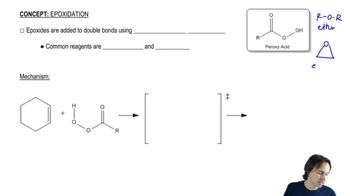
Epoxide Reactivity

Epoxides, such as ethylene oxide, are three-membered cyclic ethers that are highly reactive due to the strain in their ring structure. They can undergo nucleophilic ring-opening reactions, where a nucleophile attacks the less hindered carbon atom, leading to the formation of alcohols or other functional groups. Understanding the mechanism of this reaction is crucial for predicting the products formed when different nucleophiles react with epoxides.
Video consigliato:
02:19
General properties of epoxidation.

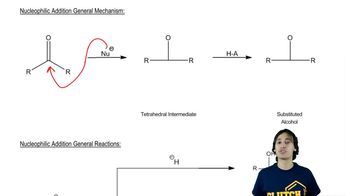
Nucleophiles

Nucleophiles are species that donate an electron pair to form a chemical bond in a reaction. In the context of the question, aniline (PhNH2), potassium cyanide (KCN), and sodium azide (NaN3) act as nucleophiles that will attack the epoxide. The strength and nature of the nucleophile influence the reaction pathway and the final product, making it essential to consider their reactivity and sterics when predicting outcomes.
Video consigliato:
08:27
Nucleophilic Addition

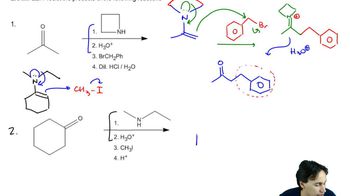
Product Prediction

Predicting the major product of a reaction involves understanding the regioselectivity and stereochemistry of the nucleophilic attack on the epoxide. Factors such as the nucleophile's structure, the reaction conditions, and the stability of the resulting intermediates play a significant role in determining which product is favored. Analyzing these aspects allows for accurate predictions of the major products formed in the reactions with ethylene oxide.
Video consigliato:
03:13
Predict the Products