Ch. 14 - Ethers, Epoxides, and Thioethers
Wade - Organic Chemistry 9th Edition
Wade9th EditionOrganic ChemistryISBN: 9780135213728Non è quello che usi tu?Cambia libro di testo
Capitolo 14, Problema 12

Chemical reaction showing the acid-catalyzed condensation of n-propyl alcohol to n-propyl ether, with water as a byproduct.
Propose a mechanism for the acid-catalyzed condensation of n-propyl alcohol to n-propyl ether, as shown above. When the temperature is allowed to rise too high, propene is formed. Propose a mechanism for the formation of propene, and explain why it is favored at higher temperatures.

Guida verificata passo dopo passo
1
Step 1: Begin by understanding the acid-catalyzed condensation mechanism for the formation of n-propyl ether from n-propyl alcohol. The process typically involves protonation of the alcohol to form a good leaving group.
Step 2: Protonation of n-propyl alcohol occurs when the alcohol oxygen atom donates a pair of electrons to a hydrogen ion (H⁺) from the acid catalyst, forming an oxonium ion. This is represented as: CH3CH2CH2-OH+H+→CH3CH2CH2-OH+
Step 3: The oxonium ion can then undergo nucleophilic attack by another molecule of n-propyl alcohol, leading to the formation of n-propyl ether. This step involves the displacement of water as a leaving group, forming the ether linkage.
Step 4: For the formation of propene at higher temperatures, consider the elimination mechanism. The oxonium ion can lose a water molecule, forming a carbocation intermediate. This is followed by a deprotonation step, where a hydrogen ion is removed from the adjacent carbon, resulting in the formation of propene. This is represented as: CH3CH2CH2-OH+→CH3CH2-CH+→CH3CH=CH2
Step 5: Explain why propene formation is favored at higher temperatures. The elimination reaction leading to propene is an endothermic process, which means it requires heat to proceed. At higher temperatures, the energy barrier for elimination is overcome more easily, favoring the formation of propene over the condensation reaction.

Risposta video verificata per un problema simile:

Questa soluzione video è stata consigliata dai nostri tutor come utile per risolvere questo problema.
Durata del video:
6m

Concetti chiave

Ecco i concetti essenziali che devi comprendere per rispondere correttamente alla domanda.

Acid-Catalyzed Condensation

Acid-catalyzed condensation is a reaction where an acid facilitates the formation of an ether from alcohols by promoting the nucleophilic attack of an alcohol on another alcohol molecule. The acid protonates the hydroxyl group, making it a better leaving group, which allows for the formation of a new C-O bond and the release of water. This process is crucial for understanding how n-propyl alcohol can be converted into n-propyl ether.
Video consigliato:
03:09
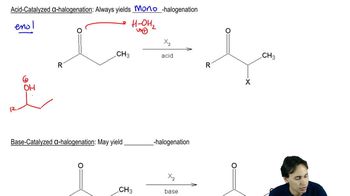
Acid Catalyzed

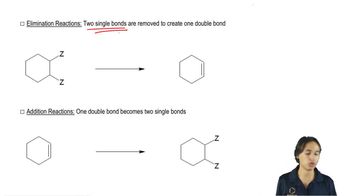
Elimination Reaction

An elimination reaction involves the removal of a small molecule from a larger one, resulting in the formation of a double bond. In the context of n-propyl alcohol, when the temperature increases, the reaction can shift towards elimination, leading to the formation of propene. This occurs because higher temperatures favor the formation of products with greater entropy, such as alkenes, over the more stable ether.
Video consigliato:
00:40
Recognizing Elimination Reactions.

Le Chatelier's Principle

Le Chatelier's Principle states that if a system at equilibrium is disturbed, the system will adjust to counteract the disturbance and restore a new equilibrium. In the case of the acid-catalyzed condensation and subsequent elimination reactions, increasing the temperature shifts the equilibrium towards the formation of propene, as the system seeks to minimize the effect of the added heat by favoring the endothermic elimination process.
Video consigliato:
04:12
The Electron Configuration