Ch. 14 - Ethers, Epoxides, and Thioethers
Wade - Organic Chemistry 9th Edition
Wade9th EditionOrganic ChemistryISBN: 9780135213728Non è quello che usi tu?Cambia libro di testo
Capitolo 14, Problema 20e

Show how you would accomplish the following transformations. Some of these examples require more than one step.
(e) 2-chlorohexan-1-ol → 1,2-epoxyhexane

Guida verificata passo dopo passo
1
Step 1: Recognize that the transformation involves converting a 2-chlorohexan-1-ol into 1,2-epoxyhexane. This requires the formation of an epoxide, which typically involves an intramolecular reaction of a halohydrin.
Step 2: Begin by identifying the functional groups in the starting material. 2-chlorohexan-1-ol contains both a hydroxyl (-OH) group and a chloro (-Cl) group on adjacent carbons, which is ideal for epoxide formation.
Step 3: Treat the compound with a base, such as sodium hydroxide (NaOH). The base will deprotonate the hydroxyl group, forming an alkoxide ion (R-O⁻). This alkoxide ion is a strong nucleophile.
Step 4: The alkoxide ion will perform an intramolecular nucleophilic substitution (S_N2 mechanism) on the carbon bearing the chlorine atom. This results in the formation of the epoxide ring (1,2-epoxyhexane) and the elimination of the chloride ion (Cl⁻).
Step 5: Verify the stereochemistry of the product, if applicable, as the S_N2 mechanism can lead to inversion of configuration at the carbon where substitution occurs. Ensure the final product matches the desired structure of 1,2-epoxyhexane.

Risposta video verificata per un problema simile:

Questa soluzione video è stata consigliata dai nostri tutor come utile per risolvere questo problema.
Durata del video:
2m

Concetti chiave

Ecco i concetti essenziali che devi comprendere per rispondere correttamente alla domanda.

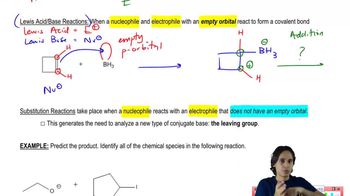
Nucleophilic Substitution

Nucleophilic substitution is a fundamental reaction in organic chemistry where a nucleophile replaces a leaving group in a molecule. In the transformation from 2-chlorohexan-1-ol to 1,2-epoxyhexane, the chlorine atom acts as a leaving group, allowing a nucleophile to attack the carbon atom and facilitate the formation of a new bond.
Video consigliato:
01:47
Nucleophiles and Electrophiles can react in Substitution Reactions.

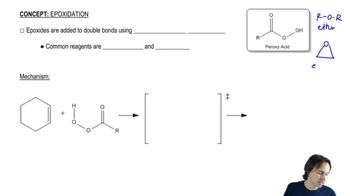
Epoxidation

Epoxidation is the process of converting alkenes into epoxides, which are three-membered cyclic ethers. This transformation typically involves the reaction of an alkene with a peracid, leading to the formation of an epoxide. In the context of the given transformation, the formation of 1,2-epoxyhexane from 2-chlorohexan-1-ol may involve an intermediate alkene that undergoes epoxidation.
Video consigliato:
02:19
General properties of epoxidation.

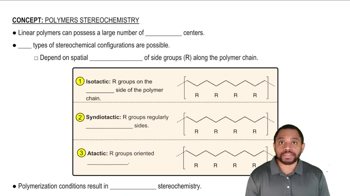
Stereochemistry

Stereochemistry refers to the study of the spatial arrangement of atoms in molecules and how this affects their chemical behavior. In the transformation to 1,2-epoxyhexane, understanding the stereochemistry is crucial, as the formation of the epoxide can lead to different stereoisomers depending on the configuration of the starting material and the reaction conditions.
Video consigliato:
Percorso guidato
1:38
Polymer Stereochemistry Concept 1
Pratica correlata
Domanda del libro di testo

Show how you would accomplish the following transformations. Some of these examples require more than one step.

(a) 2-methylpropene → 2,2-dimethyloxirane

(b) 1-phenylethanol → 2-phenyloxirane

(c) 5-chloropent-1-ene → tetrahydropyran

1111
views
Domanda del libro di testo

Propose mechanisms for the epoxidation and ring-opening steps of the epoxidation and hydrolysis of trans-but-2-ene shown above. Predict the product of the same reaction with cis-but-2-ene.

2471
views
Domanda del libro di testo

The 2001 Nobel Prize in Chemistry was awarded to three organic chemists who have developed methods for catalytic asymmetric syntheses. An asymmetric (or enantioselective) synthesis is one that converts an achiral starting material into mostly one enantiomer of a chiral product. K. Barry Sharpless (The Scripps Research Institute) developed an asymmetric epoxidation of allylic alcohols that gives excellent chemical yields and greater than 90% enantiomeric excess.

The Sharpless epoxidation uses tert-butyl hydroperoxide, titanium(IV) isopropoxide, and a dialkyl tartrate ester as the reagents. The following epoxidation of geraniol is typical.

(a) Which of these reagents is most likely to be the actual oxidizing agent? That is, which reagent is reduced in the reaction? What is the likely function of the other reagents?

(b) When achiral reagents react to give a chiral product, that product is normally formed as a racemic mixture of enantiomers. How can the Sharpless epoxidation give just one nearly pure enantiomer of the product?

(c) Draw the other enantiomer of the product. What reagents would you use if you wanted to epoxidize geraniol to give this other enantiomer?

1280
views
Domanda del libro di testo

Show how you would use a protecting group to convert 4-bromobutan-1-ol to hept-5-yn-1-ol.

1196
views
Domanda del libro di testo

Show how you would accomplish the following transformations. Some of these examples require more than one step.

(d) 5-chloropent-1-ene → 2-methyltetrahydrofuran 

968
views
Domanda del libro di testo

Cellosolve® is the trade name for 2-ethoxyethanol, a common industrial solvent. This compound is produced in chemical plants that use ethylene as their only organic feedstock. Show how you would accomplish this industrial process.

1039
views