Ch. 14 - Ethers, Epoxides, and Thioethers
Wade - Organic Chemistry 9th Edition
Wade9th EditionOrganic ChemistryISBN: 9780135213728Non è quello che usi tu?Cambia libro di testo
Capitolo 14, Problema 29d,e,f

Write structural formulas for the following compounds.
(d) divinyl ether
(e) allyl methyl ether
(f) cyclohexene oxide

Guida verificata passo dopo passo
1
Step 1: Understand the naming conventions for ethers and epoxides. Ethers are compounds containing an oxygen atom bonded to two alkyl or aryl groups. Epoxides are cyclic ethers with a three-membered ring containing one oxygen atom.
Step 2: For divinyl ether, recognize that 'divinyl' refers to two vinyl groups (CH₂=CH−). The structural formula will involve an oxygen atom bonded to two vinyl groups. Write the structure as CH₂=CH−O−CH=CH₂.
Step 3: For allyl methyl ether, identify the 'allyl' group (CH₂=CH−CH₂−) and the 'methyl' group (CH₃−). The oxygen atom connects these two groups. Write the structure as CH₂=CH−CH₂−O−CH₃.
Step 4: For cyclohexene oxide, recognize that 'cyclohexene' refers to a six-membered ring with one double bond, and 'oxide' indicates the presence of an epoxide ring. Draw a cyclohexene structure and add a three-membered epoxide ring across the double bond.
Step 5: Verify each structure by ensuring the correct connectivity of atoms and adherence to IUPAC naming conventions. Confirm that the oxygen atom is appropriately bonded in each case and that the structures match the names provided.

Risposta video verificata per un problema simile:

Questa soluzione video è stata consigliata dai nostri tutor come utile per risolvere questo problema.
Durata del video:
5m

Concetti chiave

Ecco i concetti essenziali che devi comprendere per rispondere correttamente alla domanda.

Structural Formulas

Structural formulas represent the arrangement of atoms within a molecule, showing how atoms are bonded together. They provide insight into the molecular geometry and functional groups present, which are crucial for understanding the compound's reactivity and properties. In organic chemistry, structural formulas can be depicted in various ways, including Lewis structures, condensed formulas, and skeletal formulas.
Video consigliato:
05:21
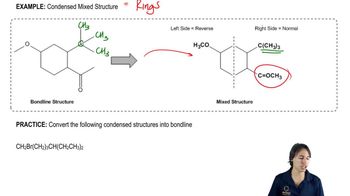
How to draw condensed mixed structures.

Ethers

Ethers are a class of organic compounds characterized by an oxygen atom bonded to two alkyl or aryl groups. They are generally represented by the general formula R-O-R', where R and R' can be the same or different. Ethers are known for their relatively low reactivity and are commonly used as solvents and in various chemical reactions, making their structural representation important for understanding their behavior in organic synthesis.
Video consigliato:
04:22
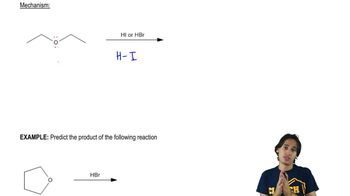
How to predict the products of Ether Cleavage.

Cycloalkenes and Epoxides

Cycloalkenes are cyclic compounds that contain at least one carbon-carbon double bond, which affects their stability and reactivity. Epoxides, or oxiranes, are three-membered cyclic ethers formed from alkenes through oxidation, making them highly reactive due to ring strain. Understanding the structure and reactivity of these compounds is essential for predicting their behavior in chemical reactions and their applications in organic synthesis.
Video consigliato:
02:19
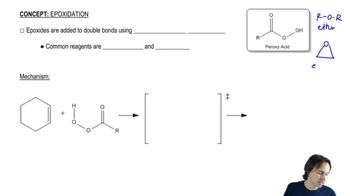
General properties of epoxidation.