Ch. 15 - Conjugated Systems, Orbital Symmetry, and Ultraviolet Spectroscopy
Wade - Organic Chemistry 9th Edition
Wade9th EditionOrganic ChemistryISBN: 9780135213728Non è quello che usi tu?Cambia libro di testo
Capitolo 15, Problema 20b

There is a different, thermally allowed cycloaddition of two butadiene molecules. Show this reaction, and explain why it is thermally allowed. (Hint: Consider the dimerization of cyclopentadiene.)

Guida verificata passo dopo passo
1
Step 1: Recognize that the reaction involves two butadiene molecules undergoing a cycloaddition reaction. Cycloaddition reactions are a type of pericyclic reaction where two π-systems combine to form a cyclic product.
Step 2: Recall the Woodward-Hoffmann rules for pericyclic reactions. These rules state that cycloaddition reactions are thermally allowed if the total number of (4n+2) π-electrons involved in the reaction is conserved. For butadiene, each molecule contributes 4 π-electrons, resulting in a total of 8 π-electrons.
Step 3: Analyze the orbital symmetry of the butadiene molecules. In a thermally allowed cycloaddition, the reaction proceeds via a suprafacial interaction of the π-electrons on both molecules. This is consistent with the conservation of orbital symmetry.
Step 4: Compare this reaction to the dimerization of cyclopentadiene, which is a [4+2] cycloaddition reaction. In the case of butadiene, the reaction is a [4+4] cycloaddition, where two sets of 4 π-electrons combine to form a new cyclic structure.
Step 5: Draw the product of the reaction. The two butadiene molecules combine to form a cyclooctadiene structure. This is thermally allowed because the reaction follows the Woodward-Hoffmann rules and conserves orbital symmetry.

Risposta video verificata per un problema simile:

Questa soluzione video è stata consigliata dai nostri tutor come utile per risolvere questo problema.
Durata del video:
13m

Concetti chiave

Ecco i concetti essenziali che devi comprendere per rispondere correttamente alla domanda.

Cycloaddition Reactions

Cycloaddition reactions involve the formation of a cyclic compound from two or more reactants, typically involving the overlap of π bonds. In the case of butadiene, two molecules can undergo a [4+2] cycloaddition, where the diene and a dienophile react to form a six-membered ring. This type of reaction is significant in organic synthesis and polymer chemistry.
Video consigliato:
08:29
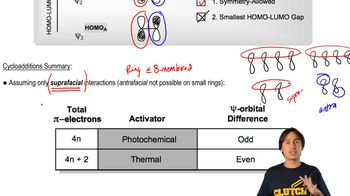
Cycloadditions Summary Chart

Thermal vs. Photochemical Reactions

Thermal reactions occur at elevated temperatures and do not require light to proceed, while photochemical reactions are driven by light energy. The cycloaddition of butadiene is thermally allowed because it involves a concerted mechanism that does not require the breaking of bonds in a way that would necessitate light energy, making it favorable under heat.
Video consigliato:
09:36
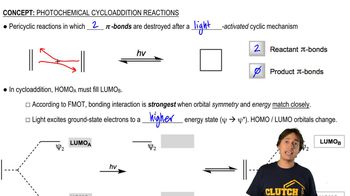
MO Theory of Photochemical Cycloadditions

Dimerization of Cyclopentadiene

The dimerization of cyclopentadiene serves as an example of a thermal cycloaddition reaction. When cyclopentadiene dimerizes, it forms a stable product through a [4+2] cycloaddition mechanism. This reaction illustrates the concept of thermally allowed cycloadditions, as it proceeds without the need for light and demonstrates the stability of the resulting cyclic compound.
Video consigliato:
05:39
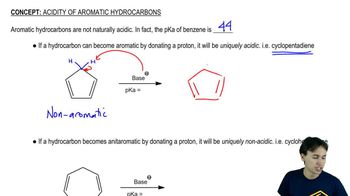
Aromatic hydrocarbon acidity