Ch. 15 - Conjugated Systems, Orbital Symmetry, and Ultraviolet Spectroscopy
Wade - Organic Chemistry 9th Edition
Wade9th EditionOrganic ChemistryISBN: 9780135213728Non è quello che usi tu?Cambia libro di testo
Capitolo 15, Problema 25g

Predict the products of the following reactions.
(g) 1-(bromomethyl)-2-methylcyclopentene, heated in methanol

Guida verificata passo dopo passo
1
Identify the functional groups in the given compound, 1-(bromomethyl)-2-methylcyclopentene. The molecule contains a bromomethyl group (-CH2Br), a methyl group (-CH3), and a double bond in the cyclopentene ring.
Recognize the reaction conditions: the compound is heated in methanol. Methanol (CH3OH) is a polar protic solvent, which can act as a nucleophile or participate in solvolysis reactions.
Determine the likely reaction mechanism. The presence of a bromomethyl group suggests that the reaction may proceed via an SN1 or SN2 mechanism, depending on the stability of the intermediate and the reaction conditions. Heating typically favors solvolysis (SN1) in polar protic solvents like methanol.
In an SN1 mechanism, the bromide ion (Br⁻) leaves first, forming a carbocation intermediate. The carbocation forms at the benzylic position (the carbon attached to the bromomethyl group), which is stabilized by resonance with the double bond in the cyclopentene ring.
Once the carbocation is formed, methanol acts as a nucleophile and attacks the carbocation, leading to the formation of a new product. The final product will likely be a methoxy-substituted compound, where the bromine is replaced by a methoxy group (-OCH3).

Risposta video verificata per un problema simile:

Questa soluzione video è stata consigliata dai nostri tutor come utile per risolvere questo problema.
Durata del video:
4m

Concetti chiave

Ecco i concetti essenziali che devi comprendere per rispondere correttamente alla domanda.

Electrophilic Addition Reactions

Electrophilic addition reactions occur when an electrophile reacts with a nucleophile, resulting in the formation of a more saturated product. In the context of alkenes, the double bond acts as a nucleophile, attacking an electrophile, which can lead to the formation of various products depending on the conditions and reagents used.
Video consigliato:
05:39
Features of Addition Mechanisms.

Rearrangement Reactions

Rearrangement reactions involve the structural reorganization of a molecule, often leading to more stable products. In the case of heating 1-(bromomethyl)-2-methylcyclopentene, the heat can facilitate the migration of groups within the molecule, potentially altering the position of the bromine or the double bond, which can affect the final product.
Video consigliato:
06:28
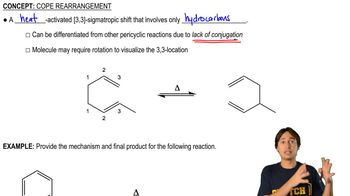
Definition of Cope Rearrangement

Nucleophilic Substitution

Nucleophilic substitution is a reaction where a nucleophile replaces a leaving group in a molecule. In this scenario, methanol acts as a nucleophile that can attack the carbon atom bonded to the bromine in 1-(bromomethyl)-2-methylcyclopentene, leading to the substitution of the bromine atom with a methoxy group, resulting in the formation of an ether.
Video consigliato:
01:47
Nucleophiles and Electrophiles can react in Substitution Reactions.