Ch. 15 - Conjugated Systems, Orbital Symmetry, and Ultraviolet Spectroscopy
Wade - Organic Chemistry 9th Edition
Wade9th EditionOrganic ChemistryISBN: 9780135213728Non è quello che usi tu?Cambia libro di testo
Capitolo 15, Problema 17a,b

We predicted that the products would have a 1,2- or 1,4-relationship of the proper substituents. Draw the charge-separated resonance forms of the reactants to support these predictions.
(a) Chemical structures of reactants for the Diels-Alder reaction, showing a conjugated system with substituents. (b) Chemical structures of reactants with OCH3 and CN groups, illustrating charge-separated resonance forms for analysis.

Guida verificata passo dopo passo
1
Identify the reactants in each image. In the first image, the reactants are isoprene (2-methyl-1,3-butadiene) and methyl vinyl ketone. In the second image, the reactants are methoxybutadiene and acrylonitrile.
For each pair of reactants, consider the possibility of a Diels-Alder reaction, which involves a diene and a dienophile. The diene is the compound with two double bonds, and the dienophile is the compound with one double bond and an electron-withdrawing group.
Draw the resonance structures for the diene and the dienophile. For the diene, show the movement of electrons to form a charge-separated structure. For the dienophile, show the electron-withdrawing group stabilizing the negative charge.
For the first pair, isoprene can form a resonance structure where one of the double bonds shifts, creating a positive charge on one carbon and a negative charge on another. Methyl vinyl ketone can form a resonance structure where the carbonyl group stabilizes a negative charge.
For the second pair, methoxybutadiene can form a resonance structure with a positive charge on the carbon adjacent to the methoxy group and a negative charge on the terminal carbon. Acrylonitrile can form a resonance structure where the cyano group stabilizes a negative charge.

Risposta video verificata per un problema simile:

Questa soluzione video è stata consigliata dai nostri tutor come utile per risolvere questo problema.
Durata del video:
7m

Concetti chiave

Ecco i concetti essenziali che devi comprendere per rispondere correttamente alla domanda.

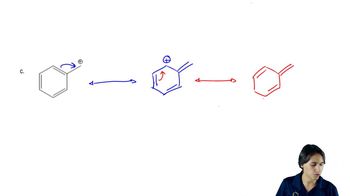
Resonance Structures

Resonance structures are different ways of drawing the same molecule that illustrate the delocalization of electrons. They help in understanding the distribution of charge and the stability of a molecule. In organic chemistry, resonance is crucial for predicting the behavior of reactants and products, especially in reactions involving conjugated systems.
Video consigliato:
03:04
Drawing Resonance Structures

Charge Separation

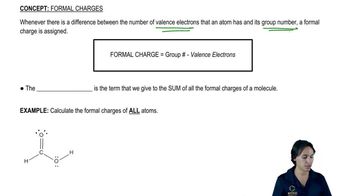
Charge separation refers to the distribution of positive and negative charges within a molecule. In resonance forms, charge separation can indicate the stability of a compound; structures with minimized charge separation are generally more stable. Understanding charge separation is essential for predicting the reactivity and product formation in organic reactions.
Video consigliato:
01:34
Calculating formal and net charge.

Substituent Positioning

The positioning of substituents on a molecule significantly influences its chemical properties and reactivity. In the context of the question, the 1,2- and 1,4-relationships refer to the relative positions of substituents on a benzene ring or similar structure. Recognizing these relationships is vital for predicting the outcomes of reactions and understanding the stability of the resulting products.
Video consigliato:
Percorso guidato
4:06
Reactions at the Allylic Position Example 3