
Ch. 16 - Aromatic Compounds
Wade - Organic Chemistry 9th Edition
Wade9th EditionOrganic ChemistryISBN: 9780135213728Non è quello che usi tu?Cambia libro di testo
Capitolo 16, Problema 40c,d

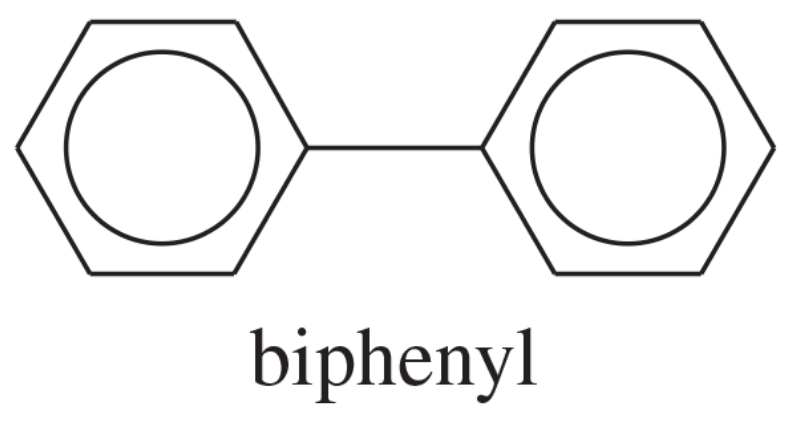
Biphenyl has the following structure.

c. The heat of hydrogenation for biphenyl is about 418 kJ/mol (100 kcal/mol). Calculate the resonance energy of biphenyl.
d. Compare the resonance energy of biphenyl with that of naphthalene and with that of two benzene rings. Explain the difference in the resonance energies of naphthalene and biphenyl.

Guida verificata passo dopo passo
1
Step 1: Understand the concept of resonance energy. Resonance energy is the stabilization energy due to delocalization of electrons in a conjugated system compared to the hypothetical energy of localized bonds. It is calculated by comparing the experimental heat of hydrogenation with the theoretical heat of hydrogenation for a system without resonance.
Step 2: Calculate the theoretical heat of hydrogenation for biphenyl. Assume that biphenyl consists of two isolated benzene rings. The heat of hydrogenation for one benzene ring is approximately 208 kJ/mol (49.8 kcal/mol). For two benzene rings, the theoretical heat of hydrogenation would be 2 × 208 kJ/mol = 416 kJ/mol.
Step 3: Compare the experimental heat of hydrogenation of biphenyl (418 kJ/mol) with the theoretical heat of hydrogenation (416 kJ/mol). The resonance energy is the difference between these values. Since the experimental value is slightly higher, this indicates minimal resonance stabilization in biphenyl.
Step 4: Compare the resonance energy of biphenyl with naphthalene. Naphthalene has a resonance energy of approximately 61 kJ/mol (14.6 kcal/mol), which is significantly higher than biphenyl. This difference arises because naphthalene has a fully conjugated system with delocalized π-electrons across two fused rings, whereas biphenyl has limited conjugation due to the twisting of the rings.
Step 5: Compare the resonance energy of biphenyl with two benzene rings. Two benzene rings have a combined resonance energy of approximately 2 × 150 kJ/mol = 300 kJ/mol. Biphenyl's resonance energy is much lower because the two rings are not conjugated due to steric hindrance and twisting, which prevents effective π-electron delocalization between the rings.

Risposta video verificata per un problema simile:

Questa soluzione video è stata consigliata dai nostri tutor come utile per risolvere questo problema.
Durata del video:
9m

Concetti chiave

Ecco i concetti essenziali che devi comprendere per rispondere correttamente alla domanda.

Resonance Energy

Resonance energy is the difference in energy between a molecule's actual structure and the energy of the most stable Lewis structure. It reflects the stabilization gained from resonance, where electrons are delocalized over multiple atoms. In biphenyl, resonance energy can be calculated by comparing the heat of hydrogenation of biphenyl to that of its fully saturated counterpart, indicating how much energy is saved due to resonance.
Video consigliato:
03:04
Drawing Resonance Structures

Heat of Hydrogenation

The heat of hydrogenation is the amount of energy released when an unsaturated compound reacts with hydrogen to become saturated. It serves as a measure of the stability of the compound; lower heat of hydrogenation indicates greater stability due to resonance. For biphenyl, the heat of hydrogenation provides a basis for calculating its resonance energy by comparing it to the heat of hydrogenation of the corresponding saturated compound.
Video consigliato:
00:48
The definition of hydrogenation.

Comparative Resonance in Polycyclic Aromatic Hydrocarbons

In polycyclic aromatic hydrocarbons like biphenyl and naphthalene, resonance energy varies due to structural differences. Naphthalene, with its fused benzene rings, has a higher resonance energy than biphenyl, which consists of two separate benzene rings. This difference arises because naphthalene allows for greater delocalization of π-electrons across its structure, leading to increased stability and lower energy compared to biphenyl.
Video consigliato:
02:41
Comparing hydrocarbon acidity
Pratica correlata
Domanda del libro di testo

For each NMR spectrum, propose a structure consistent with the spectrum and the additional information provided.

<IMAGE>

a. Elemental analysis shows the molecular formula to be C8H7OCl. The IR spectrum shows a moderate absorption at 1602 cm–1 and a strong absorption at 1690 cm–1.

b. The mass spectrum shows a double molecular ion of ratio 1:1 at m/z 184 and 186.

<IMAGE>

1863
views
Domanda del libro di testo

Biphenyl has the following structure.

a. Is biphenyl a (fused) polynuclear aromatic hydrocarbon?

b. How many pi electrons are there in the two aromatic rings of biphenyl? How does this number compare with that for naphthalene?

1440
views
Domanda del libro di testo

How would you convert the following compounds to aromatic compounds?

(d)

(e)

(f)

1773
views
1
rank
Domanda del libro di testo

Recall (Section 16-10) that two positions of anthracene sometimes react more like polyenes than like aromatic compounds.

b. The Diels–Alder reaction of anthracene with maleic anhydride is a common organic lab experiment. Predict the product of this Diels–Alder reaction.

766
views
Domanda del libro di testo

Anions of hydrocarbons are rare, and dianions of hydrocarbons are extremely rare. The following hydrocarbon reacts with two equivalents of butyllithium to form a dianion of formula [C8H6]2–. Propose a structure for this dianion, and suggest why it forms so readily.

658
views
Domanda del libro di testo

How would you convert the following compounds to aromatic compounds?

(a)

(b)

(c)

1138
views