
Ch. 16 - Aromatic Compounds
Wade - Organic Chemistry 9th Edition
Wade9th EditionOrganic ChemistryISBN: 9780135213728Non è quello che usi tu?Cambia libro di testo
Capitolo 16, Problema 50

Chlorophyll is the general name for a family of compounds present in algae and green plants. These molecules use the energy in sunlight to convert carbon dioxide and water into carbohydrates and other energy sources. At the heart of chlorophyll (shown below) is a large-ring magnesium complex called a chlorin. Circle each double bond in the large cyclic conjugated pi system that makes it aromatic. How many pi electrons are in this aromatic system?
Diagram of chlorophyll a, highlighting the chlorin ring system and indicating double bonds in the aromatic pi electron system.

Guida verificata passo dopo passo
1
Step 1: Identify the large cyclic conjugated pi system in the chlorin ring structure. This is the central ring system containing magnesium (Mg) and nitrogen atoms, along with alternating double bonds.
Step 2: Circle each double bond in the cyclic conjugated pi system. Look for alternating single and double bonds within the ring structure, which contribute to conjugation and aromaticity.
Step 3: Count the number of pi electrons in the conjugated system. Each double bond contributes 2 pi electrons, and lone pairs on nitrogen atoms may also contribute if they are part of the conjugated system.
Step 4: Apply Hückel's rule for aromaticity, which states that a molecule is aromatic if it has (4n + 2) pi electrons, where n is a non-negative integer. Verify if the total number of pi electrons satisfies this rule.
Step 5: Confirm the aromaticity of the chlorin ring system based on the conjugated pi electron count and Hückel's rule. This will determine if the system is aromatic.

Risposta video verificata per un problema simile:

Questa soluzione video è stata consigliata dai nostri tutor come utile per risolvere questo problema.
Durata del video:
5m

Concetti chiave

Ecco i concetti essenziali che devi comprendere per rispondere correttamente alla domanda.

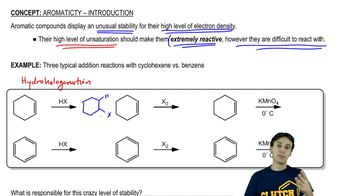
Aromaticity

Aromaticity refers to a property of cyclic compounds that exhibit enhanced stability due to the delocalization of pi electrons across the ring structure. For a compound to be considered aromatic, it must follow Hückel's rule, which states that it should have a planar structure and contain a specific number of pi electrons (4n + 2, where n is a non-negative integer). This concept is crucial for understanding the stability and reactivity of compounds like chlorophyll.
Video consigliato:
08:19
Intro to Aromaticity

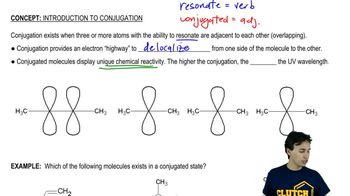
Conjugated Pi System

A conjugated pi system consists of alternating single and double bonds, allowing for the overlap of p orbitals and the delocalization of electrons. In chlorophyll, the conjugated system contributes to its aromatic character and plays a significant role in its ability to absorb light. Identifying the double bonds in this system is essential for determining the number of pi electrons involved.
Video consigliato:
05:29
Definition of Conjugation

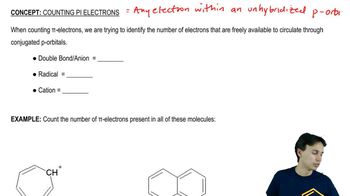
Pi Electrons

Pi electrons are the electrons found in the pi bonds of a molecule, which are formed by the sideways overlap of p orbitals. In the context of aromatic compounds, the count of pi electrons is critical for assessing aromaticity. In chlorophyll, counting the pi electrons in the cyclic conjugated system will help determine its stability and reactivity, as well as its role in photosynthesis.
Video consigliato:
01:33
Counting pi electrons