
Ch. 16 - Aromatic Compounds
Wade - Organic Chemistry 9th Edition
Wade9th EditionOrganic ChemistryISBN: 9780135213728Non è quello che usi tu?Cambia libro di testo
Capitolo 16, Problema 32d

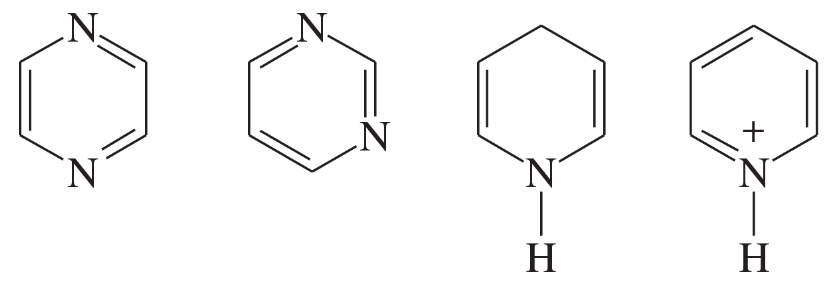
The following molecules and ions are grouped by similar structures. Classify each as aromatic, antiaromatic, or nonaromatic. For the aromatic and antiaromatic species, give the number of pi electrons in the ring.
(d)

Guida verificata passo dopo passo
1
Step 1: Analyze the structure of each molecule or ion in the image. Look for conjugated pi systems, lone pairs on heteroatoms, and charges that may affect aromaticity.
Step 2: Apply Huckel's rule for aromaticity, which states that a molecule is aromatic if it is cyclic, planar, fully conjugated, and contains (4n + 2) pi electrons, where n is an integer. Anti-aromatic molecules are cyclic, planar, fully conjugated, but contain 4n pi electrons. Non-aromatic molecules do not meet the criteria for aromaticity or anti-aromaticity.
Step 3: For the first structure (pyrimidine), count the pi electrons in the conjugated system. Include the lone pairs on nitrogen atoms if they are part of the conjugation. Determine if it satisfies Huckel's rule.
Step 4: For the second structure (1,3-diazine), repeat the process of counting pi electrons and analyzing conjugation. Check if the lone pairs on nitrogen atoms contribute to the conjugated system.
Step 5: For the third and fourth structures (pyridine and pyridinium ion), analyze the conjugated system and count the pi electrons. For pyridinium ion, consider the effect of the positive charge on nitrogen and whether it affects aromaticity.

Risposta video verificata per un problema simile:

Questa soluzione video è stata consigliata dai nostri tutor come utile per risolvere questo problema.
Durata del video:
2m

Concetti chiave

Ecco i concetti essenziali che devi comprendere per rispondere correttamente alla domanda.

Aromaticity

Aromatic compounds are cyclic, planar molecules with a ring of p-orbitals that allows for delocalization of pi electrons. They must follow Hückel's rule, which states that a molecule is aromatic if it contains 4n + 2 pi electrons, where n is a non-negative integer. This delocalization contributes to the stability and unique reactivity of aromatic compounds.
Video consigliato:
08:19
Intro to Aromaticity

Antiaromaticity

Antiaromatic compounds are also cyclic and planar but contain 4n pi electrons, leading to destabilization due to the unfavorable electron interactions. This results in a higher energy state compared to nonaromatic compounds. Antiaromaticity is characterized by a lack of stability, making these compounds less common in nature.
Video consigliato:
02:58
Determine the aromaticity

Nonaromatic Compounds

Nonaromatic compounds do not meet the criteria for aromaticity or antiaromaticity. They may be acyclic, lack planarity, or have insufficient pi electrons for delocalization. Nonaromatic compounds do not exhibit the special stability associated with aromatic compounds and can have varied reactivity depending on their structure.
Video consigliato:
01:40
Defining meso compounds.