
Ch. 16 - Aromatic Compounds
Wade - Organic Chemistry 9th Edition
Wade9th EditionOrganic ChemistryISBN: 9780135213728Non è quello che usi tu?Cambia libro di testo
Capitolo 16, Problema 43c

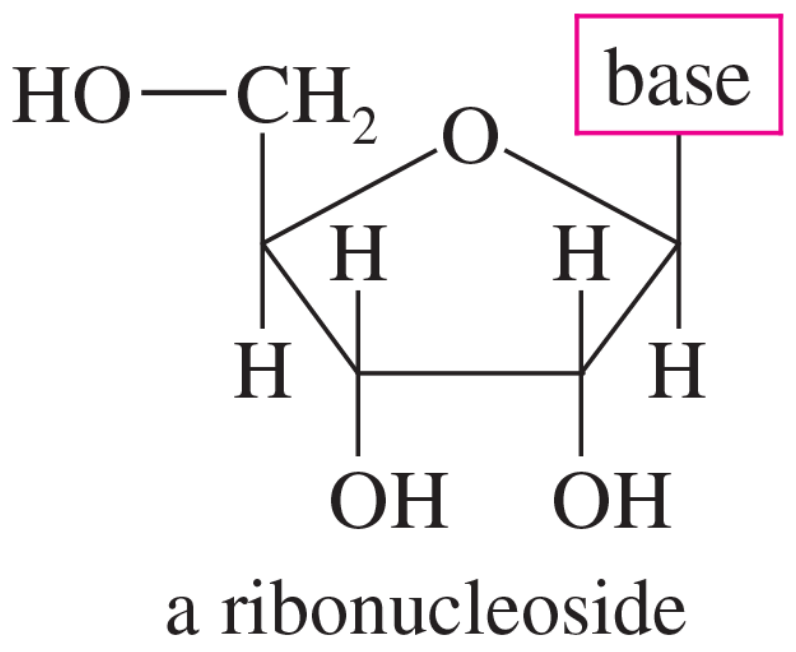
The ribonucleosides that make up ribonucleic acid (RNA) are composed of D-ribose (a sugar) and four heterocyclic “bases.” The general structure of a ribonucleoside is shown here.

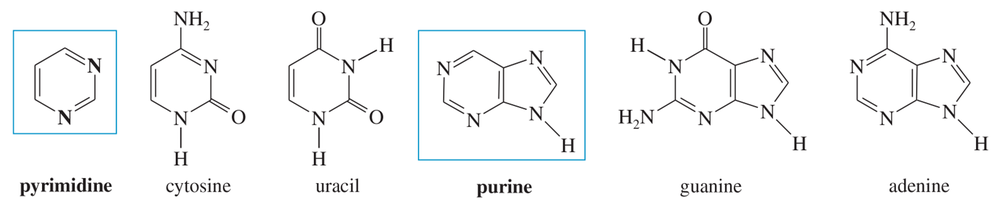
The four heterocyclic bases are cytosine, uracil, guanine, and adenine. Cytosine and uracil are called pyrimidine bases because their structures resemble pyrimidine. Guanine and adenine are called purine bases because their structures resemble purine.

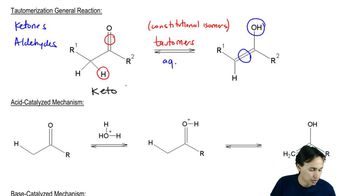
c. Do any of these bases have easily formed tautomers that are aromatic? (Consider moving a proton from nitrogen to a carbonyl group to form a phenolic derivative.)

Guida verificata passo dopo passo
1
Examine the structures of the bases provided: cytosine, uracil, guanine, and adenine. Note that cytosine and uracil are pyrimidine derivatives, while guanine and adenine are purine derivatives.
Identify the presence of functional groups that can participate in tautomerization. Specifically, look for nitrogen atoms adjacent to carbonyl groups, as these are common sites for proton transfer in tautomerization.
Consider the tautomerization mechanism: a proton can move from a nitrogen atom to a carbonyl oxygen, forming a phenolic derivative. This process can potentially lead to aromatic stabilization.
Analyze the aromaticity of the resulting tautomer. Aromatic compounds follow Huckel's rule, which states that a molecule must have (4n + 2) π electrons in a cyclic, planar structure to be aromatic.
Determine which bases can form aromatic tautomers. For example, uracil and cytosine have carbonyl groups and nitrogen atoms positioned such that tautomerization can lead to aromatic phenolic derivatives. Guanine and adenine, being purine derivatives, may also exhibit tautomerization, but their resulting structures need to be evaluated for aromaticity.

Risposta video verificata per un problema simile:

Questa soluzione video è stata consigliata dai nostri tutor come utile per risolvere questo problema.
Durata del video:
9m

Concetti chiave

Ecco i concetti essenziali che devi comprendere per rispondere correttamente alla domanda.

Ribonucleosides

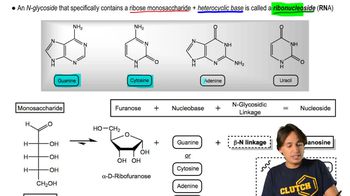
Ribonucleosides are the building blocks of RNA, consisting of a sugar (D-ribose) linked to a nitrogenous base. The structure includes a five-carbon sugar with hydroxyl groups, which distinguishes ribonucleosides from deoxyribonucleosides found in DNA. Understanding the structure of ribonucleosides is crucial for grasping how they function in genetic coding and protein synthesis.
Video consigliato:
05:29
Creating Ribonucleosides

Pyrimidine and Purine Bases

The four nitrogenous bases in RNA are categorized into two groups: pyrimidines (cytosine and uracil) and purines (guanine and adenine). Pyrimidines have a single six-membered ring structure, while purines consist of a fused double-ring system. This classification is essential for understanding base pairing in nucleic acids and the overall structure of RNA.
Video consigliato:
Percorso guidato
1:09
Nitrogenous Bases Example 1

Tautomerism and Aromaticity

Tautomerism refers to the ability of certain compounds to exist in two interconvertible forms, often involving the relocation of a proton. In the context of the nitrogenous bases, some tautomers can exhibit aromatic characteristics, which can influence their stability and reactivity. Recognizing these properties is important for understanding the chemical behavior of nucleobases in biological systems.
Video consigliato:
05:11
Tautomerization Mechanisms
Pratica correlata
Domanda del libro di testo

The ribonucleosides that make up ribonucleic acid (RNA) are composed of D-ribose (a sugar) and four heterocyclic “bases.” The general structure of a ribonucleoside is shown here.

The four heterocyclic bases are cytosine, uracil, guanine, and adenine. Cytosine and uracil are called pyrimidine bases because their structures resemble pyrimidine. Guanine and adenine are called purine bases because their structures resemble purine.

b. Predict which nitrogen atoms are basic.

620
views
Domanda del libro di testo

Hexahelicene seems a poor candidate for optical activity because all its carbon atoms are sp2 hybrids and presumably flat. Nevertheless, hexahelicene has been synthesized and separated into enantiomers. Its optical rotation is enormous: [α]D = 3700°. Explain why hexahelicene is optically active, and speculate as to why the rotation is so large.

747
views
Domanda del libro di testo

The ribonucleosides that make up ribonucleic acid (RNA) are composed of D-ribose (a sugar) and four heterocyclic “bases.” The general structure of a ribonucleoside is shown here.

The four heterocyclic bases are cytosine, uracil, guanine, and adenine. Cytosine and uracil are called pyrimidine bases because their structures resemble pyrimidine. Guanine and adenine are called purine bases because their structures resemble purine.

a. Determine which rings of these bases are aromatic.

914
views
Domanda del libro di testo

An unknown compound gives the following mass, IR, and NMR spectra. Propose a structure, and show how it is consistent with the spectra. Show the fragmentations that give the prominent peaks at m/z 127 and 155 in the mass spectrum.

<IMAGES>

3377
views
Domanda del libro di testo

How would you convert the following compounds to aromatic compounds?

(d)

(e)

(f)

1773
views
1
rank
Domanda del libro di testo

Consider the following compound, which has been synthesized and characterized:

a. Assuming this molecule is entirely conjugated, do you expect it to be aromatic, antiaromatic, or nonaromatic?

b. Why was this molecule synthesized with three tert-butyl substituents? Why not make the unsubstituted compound and study it instead?

818
views