
Ch. 17 - Reactions of Aromatic Compounds
Wade - Organic Chemistry 9th Edition
Wade9th EditionOrganic ChemistryISBN: 9780135213728Non è quello che usi tu?Cambia libro di testo
Capitolo 17, Problema 5b

(b) Explain why m-xylene undergoes nitration 100 times faster than p-xylene.

Guida verificata passo dopo passo
1
Understand the nitration reaction: Nitration is an electrophilic aromatic substitution reaction where a nitro group (-NO₂) is introduced into the aromatic ring. The rate of this reaction depends on the electron density of the aromatic ring and the positions of substituents.
Analyze the structure of m-xylene and p-xylene: Both compounds are derivatives of xylene (dimethylbenzene). In m-xylene, the two methyl groups are positioned meta to each other, while in p-xylene, the two methyl groups are positioned para to each other.
Consider the electron-donating effect of methyl groups: Methyl groups are electron-donating through both inductive (+I) and hyperconjugation effects. This increases the electron density on the aromatic ring, making it more reactive toward electrophiles like the nitronium ion (NO₂⁺).
Examine the steric hindrance in p-xylene: In p-xylene, the two methyl groups are positioned opposite each other, which can create steric hindrance at the para position. This steric hindrance can slow down the approach of the electrophile, reducing the rate of nitration compared to m-xylene.
Conclude the reasoning: In m-xylene, the methyl groups are positioned meta to each other, which minimizes steric hindrance and allows for a higher electron density at the reactive positions. This makes m-xylene undergo nitration much faster than p-xylene.

Risposta video verificata per un problema simile:

Questa soluzione video è stata consigliata dai nostri tutor come utile per risolvere questo problema.
Durata del video:
6m

Concetti chiave

Ecco i concetti essenziali che devi comprendere per rispondere correttamente alla domanda.

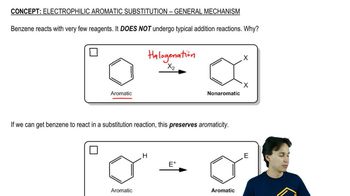
Electrophilic Aromatic Substitution

Electrophilic aromatic substitution (EAS) is a fundamental reaction in organic chemistry where an electrophile replaces a hydrogen atom on an aromatic ring. The reaction is facilitated by the stability of the aromatic system, which allows for the formation of a resonance-stabilized carbocation intermediate. Understanding EAS is crucial for analyzing the reactivity of substituted aromatic compounds, such as m-xylene and p-xylene, in nitration reactions.
Video consigliato:
03:07
EAS Review

Substituent Effects

Substituent effects refer to how different groups attached to an aromatic ring influence its reactivity and orientation during electrophilic substitution. Electron-donating groups, like methyl groups in xylene, increase the electron density of the ring, enhancing its reactivity towards electrophiles. The position of these substituents (ortho, meta, para) also affects the rate of reaction, with m-xylene being more reactive than p-xylene due to the favorable resonance stabilization of the intermediate formed during nitration.
Video consigliato:
Percorso guidato
2:02
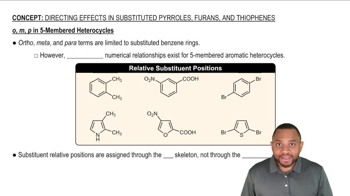
Directing Effects in Substituted Pyrroles, Furans, and Thiophenes Concept 1

Resonance Stabilization

Resonance stabilization is a key concept in organic chemistry that describes how the electron density in a molecule can be delocalized over multiple atoms, leading to increased stability. In the case of m-xylene, the formation of a resonance-stabilized carbocation during nitration is more favorable compared to p-xylene. This increased stabilization in m-xylene's transition state results in a significantly faster reaction rate, making it more reactive towards nitration.
Video consigliato:
03:43
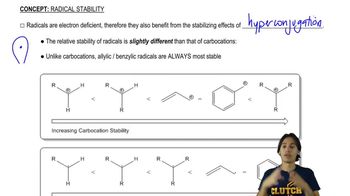
The radical stability trend.