
Ch. 17 - Reactions of Aromatic Compounds
Wade - Organic Chemistry 9th Edition
Wade9th EditionOrganic ChemistryISBN: 9780135213728Non è quello che usi tu?Cambia libro di testo
Capitolo 17, Problema 60d

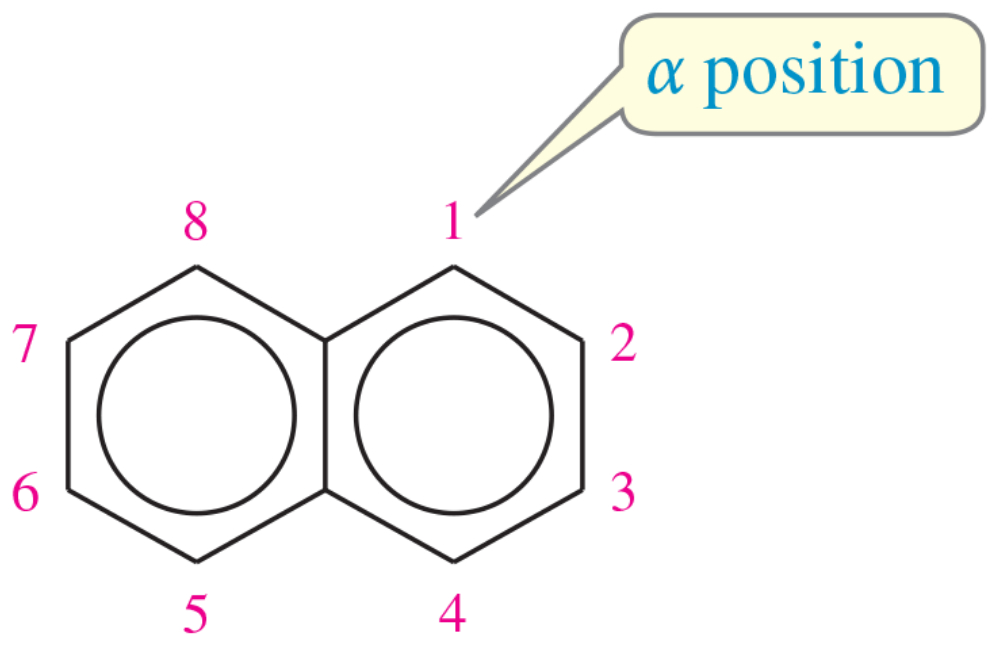
Electrophilic aromatic substitution usually occurs at the 1-position of naphthalene, also called the a position. Predict the major products of the reactions of naphthalene with the following reagents.

(d) isobutylene and HF

Guida verificata passo dopo passo
1
Step 1: Understand the reaction type. The problem involves electrophilic aromatic substitution (EAS), a reaction where an electrophile replaces a hydrogen atom on an aromatic ring. Naphthalene, a polycyclic aromatic hydrocarbon, undergoes EAS preferentially at the 1-position (α position) due to its higher electron density and stability of the intermediate carbocation.
Step 2: Analyze the reagents. Isobutylene (CH₂=C(CH₃)₂) and HF are used in this reaction. HF acts as a catalyst to protonate isobutylene, generating a carbocation (CH₃-C⁺(CH₃)-CH₃), which serves as the electrophile in the EAS reaction.
Step 3: Predict the site of attack. The carbocation electrophile will attack the α position (1-position) of naphthalene because this position leads to the formation of the most stable intermediate carbocation during the reaction.
Step 4: Draw the intermediate. After the electrophile attacks the α position, a resonance-stabilized carbocation intermediate is formed. This intermediate redistributes the positive charge across the aromatic system, stabilizing the structure.
Step 5: Complete the reaction. The final product is formed when the intermediate loses a proton, restoring aromaticity to the naphthalene ring. The major product will be naphthalene substituted at the α position with the isobutyl group (CH₂-C(CH₃)₂).

Risposta video verificata per un problema simile:

Questa soluzione video è stata consigliata dai nostri tutor come utile per risolvere questo problema.
Durata del video:
2m

Concetti chiave

Ecco i concetti essenziali che devi comprendere per rispondere correttamente alla domanda.

Electrophilic Aromatic Substitution (EAS)

Electrophilic Aromatic Substitution is a fundamental reaction in organic chemistry where an electrophile replaces a hydrogen atom on an aromatic ring. This reaction typically occurs at positions that are more reactive due to the stability of the aromatic system. In naphthalene, the 1-position (alpha position) is particularly reactive due to its ability to stabilize the positive charge formed during the reaction.
Video consigliato:
03:07
EAS Review

Naphthalene Structure and Reactivity

Naphthalene is a polycyclic aromatic hydrocarbon consisting of two fused benzene rings. Its structure allows for multiple substitution positions, with the 1-position being the most favorable for electrophilic attack. Understanding the reactivity of naphthalene is crucial for predicting the products of reactions, especially when considering steric and electronic effects.
Video consigliato:
01:17
Reactivity of Molecules

Reagents in EAS Reactions

In the context of EAS reactions, reagents such as isobutylene and HF can influence the outcome of the substitution. Isobutylene can act as a source of a carbocation, while HF can provide a protonation step. The nature of these reagents affects the stability of the intermediates and the final products, making it essential to analyze their roles in the reaction mechanism.
Video consigliato:
Percorso guidato
3:22
EAS Reactions of Pyridine Concept 3
Pratica correlata
Domanda del libro di testo

The most common selective herbicide for killing broadleaf weeds is 2,4-dichlorophenoxyacetic acid (2,4-D). Show how you would synthesize 2,4-D from benzene, chloroacetic acid (ClCH2COOH), and any necessary reagents and solvents.

1579
views
Domanda del libro di testo

Furan undergoes electrophilic aromatic substitution more readily than benzene; mild reagents and conditions are sufficient. For example, furan reacts with bromine to give 2-bromofuran.

a. Propose mechanisms for the bromination of furan at the 2-position and at the 3-position. Draw the resonance forms of each sigma complex, and compare their stabilities.

3491
views
Domanda del libro di testo

Electrophilic aromatic substitution usually occurs at the 1-position of naphthalene, also called the 1-position. Predict the major products of the reactions of naphthalene with the following reagents.

(e) cyclohexanol and BF3

694
views
Domanda del libro di testo

α-Tetralone undergoes Birch reduction to give an excellent yield of a single product. Predict the structure of the product, and propose a mechanism for its formation.

1154
views
Domanda del libro di testo

Show the products you expect when each compound reacts with NBS with light shining on the reaction.

(d)

751
views
Domanda del libro di testo

Electrophilic aromatic substitution usually occurs at the 1-position of naphthalene, also called the a position. Predict the major products of the reactions of naphthalene with the following reagents.

(a) HNO3, H2SO4

(b) Br2, FeBr3

(c) CH3CH2COCl, AlCl3

1346
views