Ch. 17 - Reactions of Aromatic Compounds
Wade - Organic Chemistry 9th Edition
Wade9th EditionOrganic ChemistryISBN: 9780135213728Non è quello che usi tu?Cambia libro di testo
Capitolo 17, Problema 50k,l

Predict the major products formed when benzene reacts (just once) with the following reagents.
(k) carbon monoxide, HCl, and AlCl3/CuCl
(l) CH2(COCl)2, AlCl3

Guida verificata passo dopo passo
1
Step 1: Recognize the type of reaction involved. Both reactions involve electrophilic aromatic substitution (EAS), where benzene reacts with an electrophile to form a substituted benzene derivative.
Step 2: For reaction (k), identify the reagents: carbon monoxide (CO), HCl, and AlCl3/CuCl. This combination is used in the Gattermann-Koch reaction, which introduces a formyl group (-CHO) onto the benzene ring. The electrophile generated in this reaction is the formyl cation (HCO⁺).
Step 3: In the Gattermann-Koch reaction, the formyl cation (HCO⁺) is generated by the reaction of CO and HCl in the presence of AlCl3 and CuCl. This electrophile then reacts with benzene to form benzaldehyde (C6H5CHO) as the major product.
Step 4: For reaction (l), identify the reagents: CH2(COCl)2 and AlCl3. This combination is used in a Friedel-Crafts acylation reaction. The reagent CH2(COCl)2 is malonyl chloride, and in the presence of AlCl3, it generates an acylium ion (CH(CO)⁺) as the electrophile.
Step 5: In the Friedel-Crafts acylation reaction, the acylium ion (CH(CO)⁺) reacts with benzene to form a substituted benzene derivative. The major product is benzene with a CH(CO) group attached, specifically phenylacetyl chloride (C6H5CH(CO)Cl).

Risposta video verificata per un problema simile:

Questa soluzione video è stata consigliata dai nostri tutor come utile per risolvere questo problema.
Durata del video:
5m

Concetti chiave

Ecco i concetti essenziali che devi comprendere per rispondere correttamente alla domanda.

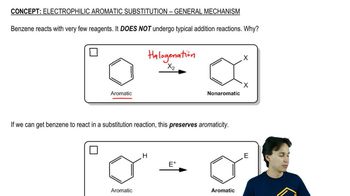
Electrophilic Aromatic Substitution

Electrophilic aromatic substitution (EAS) is a fundamental reaction mechanism in organic chemistry where an electrophile replaces a hydrogen atom on an aromatic ring. This process is crucial for understanding how benzene and its derivatives react with various reagents, leading to the formation of substituted aromatic compounds. The stability of the aromatic system is maintained during the reaction, making EAS a key concept in predicting the products of reactions involving benzene.
Video consigliato:
03:07
EAS Review

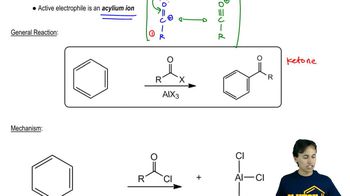
Friedel-Crafts Acylation

Friedel-Crafts acylation is a specific type of electrophilic aromatic substitution that introduces an acyl group into an aromatic ring. This reaction typically involves the use of an acyl chloride and a Lewis acid catalyst, such as AlCl3, to generate the acylium ion, which acts as the electrophile. Understanding this mechanism is essential for predicting the products when benzene reacts with acylating agents like CH2(COCl)2.
Video consigliato:
05:20
Friedel-Crafts Acylation

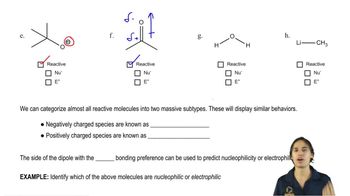
Reactivity of Electrophiles

The reactivity of electrophiles is a critical concept in organic chemistry, as it determines how readily a given electrophile will react with an aromatic compound. Factors such as the electrophile's charge, size, and the presence of electron-withdrawing or donating groups influence its strength and ability to attack the electron-rich aromatic ring. In the context of the question, understanding the nature of the electrophiles generated from the reagents is vital for predicting the major products formed in the reactions.
Video consigliato:
01:17
Reactivity of Molecules