Ch. 17 - Reactions of Aromatic Compounds
Wade - Organic Chemistry 9th Edition
Wade9th EditionOrganic ChemistryISBN: 9780135213728Non è quello che usi tu?Cambia libro di testo
Capitolo 17, Problema 12d

Predict the mononitration products of the following compounds.
d. p-methoxybenzoic acid

Guida verificata passo dopo passo
1
Identify the functional groups present in the compound. p-Methoxybenzoic acid contains a methoxy group (-OCH₃) and a carboxylic acid group (-COOH) attached to a benzene ring. The methoxy group is an electron-donating group (activating), while the carboxylic acid group is an electron-withdrawing group (deactivating).
Determine the directing effects of the substituents. The methoxy group is an ortho/para-directing group, meaning it directs incoming electrophiles to the ortho and para positions relative to itself. The carboxylic acid group is a meta-directing group, meaning it directs incoming electrophiles to the meta position relative to itself.
Analyze the combined effects of the substituents. Since the methoxy group is para to the carboxylic acid group, the positions influenced by each substituent will overlap. The methoxy group will strongly activate the para position relative to itself (which is also the meta position relative to the carboxylic acid group).
Consider the reaction conditions. Mononitration involves the introduction of a nitro group (-NO₂) to the benzene ring using a nitrating mixture (HNO₃ and H₂SO₄). The nitro group will preferentially add to the most activated position, which is the para position relative to the methoxy group.
Predict the product. The nitro group will be added to the para position relative to the methoxy group, resulting in 4-methoxy-3-nitrobenzoic acid as the mononitration product.

Risposta video verificata per un problema simile:

Questa soluzione video è stata consigliata dai nostri tutor come utile per risolvere questo problema.
Durata del video:
2m

Concetti chiave

Ecco i concetti essenziali che devi comprendere per rispondere correttamente alla domanda.

Electrophilic Aromatic Substitution

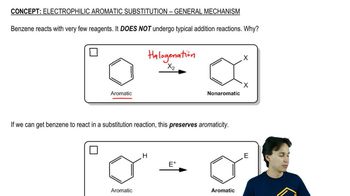
Electrophilic aromatic substitution (EAS) is a fundamental reaction in organic chemistry where an electrophile replaces a hydrogen atom on an aromatic ring. This process is crucial for understanding how substituents on the ring influence the reactivity and orientation of further substitutions, such as nitration.
Video consigliato:
03:07
EAS Review

Activating and Deactivating Groups

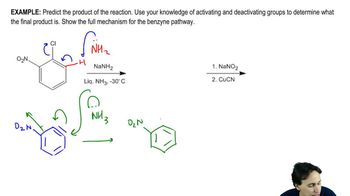
Substituents on an aromatic ring can either activate or deactivate the ring towards electrophilic substitution. Activating groups, like methoxy (-OCH3), increase electron density and direct incoming electrophiles to ortho and para positions, while deactivating groups reduce reactivity and typically direct electrophiles to the meta position.
Video consigliato:
03:27
Activating and deactivating groups

Nitration Reaction

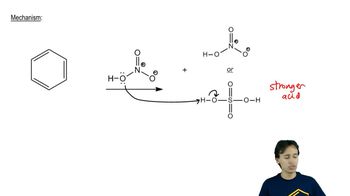
Nitration is a specific type of electrophilic aromatic substitution where a nitro group (-NO2) is introduced into an aromatic compound. The reaction typically involves the use of a nitrating mixture, such as concentrated nitric acid and sulfuric acid, and the position of nitration is influenced by the nature of existing substituents on the aromatic ring.
Video consigliato:
06:09
EAS Nitration
Pratica correlata
Domanda del libro di testo

Predict the mononitration products of the following compounds.

f. o-hydroxyacetophenone

976
views

Domanda del libro di testo

In an aqueous solution containing sodium bicarbonate, aniline reacts quickly with bromine to give 2,4,6-tribromoaniline. Nitration of aniline requires very strong conditions, however, and the yields (mostly m-nitroaniline) are poor.

c. Although nitration of aniline is slow and gives mostly meta substitution, nitration of acetanilide (PhNHCOCH3) goes quickly and gives mostly para substitution. Use resonance forms to explain this difference in reactivity.

931
views
Domanda del libro di testo

Biphenyl is two benzene rings joined by a single bond. The site of substitution for a biphenyl is determined by (1) which phenyl ring is more activated (or less deactivated), and (2) which position on that ring is most reactive, using the fact that a phenyl substituent is activating and ortho, para-directing.

a. Use resonance forms of a sigma complex to show why a phenyl substituent should be ortho, para-directing.

(vi)

640
views
Domanda del libro di testo

Biphenyl is two benzene rings joined by a single bond. The site of substitution for a biphenyl is determined by (1) which phenyl ring is more activated (or less deactivated), and (2) which position on that ring is most reactive, using the fact that a phenyl substituent is activating and ortho, para-directing.

a. Use resonance forms of a sigma complex to show why a phenyl substituent should be ortho, para-directing.

(i)

3946
views
Domanda del libro di testo

When bromine is added to two beakers, one containing phenyl isopropyl ether and the other containing cyclohexene, the bromine color in both beakers disappears. What observation could you make while performing this test that would allow you to distinguish the alkene from the aryl ether?

991
views
Domanda del libro di testo

Predict the mononitration products of the following compounds.

a. o-nitrotoluene

b. m-chlorotoluene

c. o-bromobenzoic acid

1971
views
1
rank