Ch. 17 - Reactions of Aromatic Compounds
Wade - Organic Chemistry 9th Edition
Wade9th EditionOrganic ChemistryISBN: 9780135213728Non è quello che usi tu?Cambia libro di testo
Capitolo 17, Problema 20c

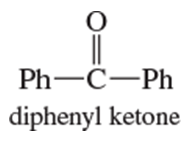
Show how you would use the Friedel–Crafts acylation, Clemmensen reduction, and/or Gatterman–Koch synthesis to prepare the following compounds:
c.

Guida verificata passo dopo passo
1
Step 1: Identify the target compound, diphenyl ketone (benzophenone), which has a ketone functional group (C=O) attached to two phenyl groups (Ph). This structure suggests the use of Friedel–Crafts acylation as a key step in the synthesis.
Step 2: Select benzene (C6H6) as the starting material. Friedel–Crafts acylation involves the reaction of an aromatic compound (benzene) with an acyl chloride in the presence of a Lewis acid catalyst, such as AlCl3.
Step 3: Choose benzoyl chloride (C6H5COCl) as the acylating agent. Benzoyl chloride contains the acyl group (C6H5CO-) needed to form the ketone functional group in the target compound.
Step 4: Perform the Friedel–Crafts acylation reaction. Mix benzene with benzoyl chloride in the presence of AlCl3. The Lewis acid catalyst facilitates the generation of the electrophilic acylium ion (C6H5CO+), which reacts with benzene to form benzophenone.
Step 5: After the reaction, isolate and purify the product, diphenyl ketone (benzophenone), using standard organic chemistry techniques such as distillation or recrystallization.

Risposta video verificata per un problema simile:

Questa soluzione video è stata consigliata dai nostri tutor come utile per risolvere questo problema.
Durata del video:
2m

Concetti chiave

Ecco i concetti essenziali che devi comprendere per rispondere correttamente alla domanda.

Friedel–Crafts Acylation

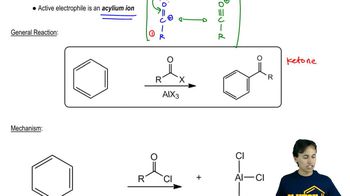
Friedel–Crafts acylation is an electrophilic aromatic substitution reaction that introduces an acyl group into an aromatic ring. This reaction typically uses an acyl chloride and a Lewis acid catalyst, such as aluminum chloride, to form a ketone. The acyl group enhances the reactivity of the aromatic compound, allowing for further functionalization. Understanding this reaction is crucial for synthesizing complex aromatic compounds.
Video consigliato:
05:20
Friedel-Crafts Acylation

Clemmensen Reduction

The Clemmensen reduction is a chemical reaction that reduces carbonyl groups (aldehydes and ketones) to methylene groups (alkanes) using zinc amalgam and hydrochloric acid. This reaction is particularly useful in organic synthesis when the carbonyl compound is sensitive to other reducing conditions. Recognizing when to apply this reduction is essential for modifying aromatic compounds after acylation.
Video consigliato:
07:12
Reductive Amination

Gatterman–Koch Synthesis

The Gatterman–Koch synthesis is a method for introducing formyl groups into aromatic compounds via the reaction of an aromatic compound with carbon monoxide and hydrochloric acid in the presence of a Lewis acid catalyst. This reaction is significant for synthesizing aldehydes from aromatic substrates, providing a pathway to further functionalization. Mastery of this synthesis is important for constructing complex aromatic systems.
Video consigliato:
Percorso guidato
1:16
Synthesis of Amino Acids: Strecker Synthesis Example 1