Ch. 17 - Reactions of Aromatic Compounds
Wade - Organic Chemistry 9th Edition
Wade9th EditionOrganic ChemistryISBN: 9780135213728Non è quello che usi tu?Cambia libro di testo
Capitolo 17, Problema 27a

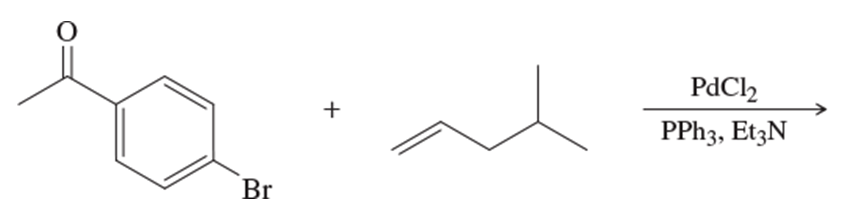
What products would you expect from the following reactions?
(a)

Guida verificata passo dopo passo
1
Step 1: Recognize that both reactions involve palladium-catalyzed coupling reactions. Specifically, these are Heck reactions, where an aryl or vinyl halide reacts with an alkene in the presence of a palladium catalyst, a phosphine ligand (PPh3), and a base (Et3N).
Step 2: For reaction (a), identify the reactants: the aryl bromide (4-bromoacetophenone) and the alkene (isobutylene). The palladium catalyst (PdCl2) facilitates the coupling of the aryl bromide with the alkene, forming a new C-C bond. The regioselectivity of the Heck reaction typically favors the formation of the product where the alkene adds to the less sterically hindered position of the aryl group.
Step 3: For reaction (b), identify the reactants: the vinyl bromide (1-bromo-2-butene) and the styrene derivative (4-methoxystyrene). The palladium catalyst (Pd(OAc)2) facilitates the coupling of the vinyl bromide with the styrene derivative. The reaction proceeds with the formation of a new C-C bond between the vinyl group and the styrene derivative, typically at the β-position of the alkene.
Step 4: Consider the stereochemistry and regioselectivity of the products. In both reactions, the Heck reaction generally proceeds with trans-selectivity, meaning the substituents on the newly formed double bond will be opposite to each other. Additionally, the electronic and steric properties of the substituents influence the regioselectivity of the coupling.
Step 5: Draw the expected products for each reaction based on the coupling mechanism, regioselectivity, and stereochemistry. For reaction (a), the product will be a substituted alkene where the isobutylene adds to the aryl group. For reaction (b), the product will be a substituted alkene where the vinyl group adds to the styrene derivative.

Risposta video verificata per un problema simile:

Questa soluzione video è stata consigliata dai nostri tutor come utile per risolvere questo problema.
Durata del video:
2m

Concetti chiave

Ecco i concetti essenziali che devi comprendere per rispondere correttamente alla domanda.

Reaction Mechanisms

Understanding reaction mechanisms is crucial in organic chemistry as it describes the step-by-step process by which reactants transform into products. This includes identifying intermediates, transition states, and the movement of electrons. Familiarity with mechanisms helps predict the outcome of reactions and the types of products formed.
Video consigliato:
02:16
Heck Reaction Mechanism

Functional Groups

Functional groups are specific groups of atoms within molecules that are responsible for the characteristic chemical reactions of those molecules. Recognizing functional groups allows chemists to predict reactivity and the types of products that can be formed during chemical reactions. Common functional groups include alcohols, carboxylic acids, and amines.
Video consigliato:
02:36
Identifying Functional Groups

Stereochemistry

Stereochemistry involves the study of the spatial arrangement of atoms in molecules and how this affects their chemical behavior. It is essential for understanding isomerism, where compounds with the same molecular formula can have different structures and properties. Stereochemical considerations can significantly influence the products of reactions, especially in chiral environments.
Video consigliato:
Percorso guidato
1:38
Polymer Stereochemistry Concept 1