Ch. 18 - Ketones and Aldehydes
Wade - Organic Chemistry 9th Edition
Wade9th EditionOrganic ChemistryISBN: 9780135213728Non è quello che usi tu?Cambia libro di testo
Capitolo 18, Problema 49d

For each compound,
1. name the functional group.
2. show what compound(s) result from complete hydrolysis.
(d) Chemical structure of an acetal with two oxygen atoms and a cyclic component, illustrating functional groups and hydrolysis.

Guida verificata passo dopo passo
1
Step 1: Identify the functional group in the compound. The structure contains two oxygen atoms connected to a cyclic structure, forming an acetal functional group. Acetals are characterized by two ether (-O-) groups attached to the same carbon atom.
Step 2: Understand the concept of hydrolysis. Hydrolysis involves breaking chemical bonds using water. For acetals, hydrolysis typically occurs under acidic conditions, breaking the acetal into its original aldehyde or ketone and alcohol components.
Step 3: Analyze the structure to determine the products of hydrolysis. The central carbon atom is bonded to two oxygen atoms and two cyclic groups. Upon hydrolysis, the acetal will break down into one molecule of the corresponding aldehyde or ketone and two molecules of alcohol.
Step 4: Predict the specific compounds formed. The cyclic groups attached to the acetal suggest that the hydrolysis will yield a cyclic ketone (likely cyclopentanone) and two molecules of alcohol (likely methanol, based on the structure).
Step 5: Verify the reaction conditions. Ensure that acidic conditions are applied for complete hydrolysis of the acetal functional group, leading to the expected products.

Risposta video verificata per un problema simile:

Questa soluzione video è stata consigliata dai nostri tutor come utile per risolvere questo problema.
Durata del video:
3m

Concetti chiave

Ecco i concetti essenziali che devi comprendere per rispondere correttamente alla domanda.

Functional Groups

Functional groups are specific groups of atoms within molecules that are responsible for the characteristic chemical reactions of those molecules. They determine the properties and reactivity of organic compounds. Common functional groups include hydroxyl (-OH), carboxyl (-COOH), and amine (-NH2), each imparting distinct behaviors to the compounds they are part of.
Video consigliato:
02:36
Identifying Functional Groups

Hydrolysis

Hydrolysis is a chemical reaction in which water is used to break down a compound. In organic chemistry, it often involves the cleavage of bonds in larger molecules, resulting in smaller molecules or functional groups. Complete hydrolysis typically refers to the full breakdown of a compound into its constituent parts, such as converting esters into acids and alcohols.
Video consigliato:
Percorso guidato
1:00
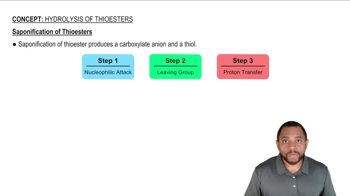
Hydrolysis of Thioesters Concept 2

Naming Organic Compounds

Naming organic compounds follows specific rules set by the International Union of Pure and Applied Chemistry (IUPAC). This systematic approach includes identifying the longest carbon chain, naming the functional groups, and assigning locants to indicate the position of substituents. Understanding these rules is essential for accurately communicating the structure and identity of organic molecules.
Video consigliato:
03:59
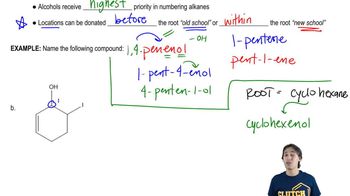
Name the following compound