Ch. 18 - Ketones and Aldehydes
Wade - Organic Chemistry 9th Edition
Wade9th EditionOrganic ChemistryISBN: 9780135213728Non è quello che usi tu?Cambia libro di testo
Capitolo 18, Problema 38j

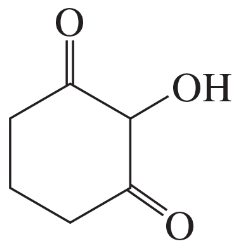
Name the following ketones and aldehydes. When possible, give both a common name and an IUPAC name.
(j)

Guida verificata passo dopo passo
1
Step 1: Identify the functional groups present in the molecule. The structure contains two ketone groups (C=O) and one hydroxyl group (-OH) attached to a cyclohexane ring.
Step 2: Determine the parent chain. The parent chain is the cyclohexane ring, as it is the largest continuous ring structure.
Step 3: Assign locants to the substituents. Number the ring to give the ketone groups the lowest possible locants. The ketone groups are located at positions 1 and 3, and the hydroxyl group is at position 5.
Step 4: Name the compound using IUPAC nomenclature. The ketone groups are indicated by the suffix '-dione,' and the hydroxyl group is indicated by the prefix 'hydroxy.' Combine these elements to form the IUPAC name.
Step 5: Provide the common name if applicable. For cyclic diketones, common names may exist based on historical naming conventions, but they are less frequently used compared to IUPAC names.

Risposta video verificata per un problema simile:

Questa soluzione video è stata consigliata dai nostri tutor come utile per risolvere questo problema.
Durata del video:
3m

Concetti chiave

Ecco i concetti essenziali che devi comprendere per rispondere correttamente alla domanda.

Functional Groups

Functional groups are specific groups of atoms within molecules that are responsible for the characteristic chemical reactions of those molecules. In the context of ketones and aldehydes, the carbonyl group (C=O) is the defining feature, with ketones having the carbonyl group bonded to two carbon atoms, while aldehydes have it bonded to at least one hydrogen atom.
Video consigliato:
02:36
Identifying Functional Groups

IUPAC Nomenclature

IUPAC nomenclature is a systematic method of naming organic chemical compounds. It provides a set of rules to derive the names of compounds based on their structure, including the identification of the longest carbon chain, the position of functional groups, and the use of prefixes and suffixes to indicate the type of compound, such as '-al' for aldehydes and '-one' for ketones.
Video consigliato:
03:43
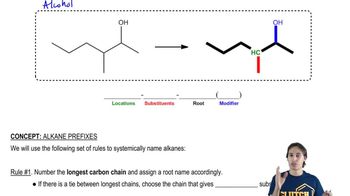
The different parts of an IUPAC name

Common Names vs. IUPAC Names

Common names are traditional names that may not follow systematic naming rules, often based on historical or trivial naming conventions. In contrast, IUPAC names are standardized and provide a clear, unambiguous way to identify compounds. Understanding both naming conventions is essential for accurately identifying and communicating about organic compounds, especially in academic and professional settings.
Video consigliato:
03:43
The different parts of an IUPAC name