Ch. 18 - Ketones and Aldehydes
Wade - Organic Chemistry 9th Edition
Wade9th EditionOrganic ChemistryISBN: 9780135213728Non è quello che usi tu?Cambia libro di testo
Capitolo 18, Problema 39j

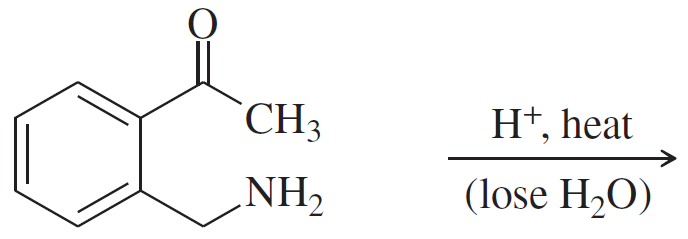
Predict the major products of the following reactions.
(j)

Guida verificata passo dopo passo
1
Step 1: Analyze the structure of the reactant. The molecule contains a ketone group (C=O) and a primary amine (-NH2) attached to a cyclopentane ring. The reaction involves acidic conditions (H+).
Step 2: Recognize the reaction type. Under acidic conditions, a ketone and a primary amine can undergo a condensation reaction to form an imine. This is known as imine formation.
Step 3: Describe the mechanism. The ketone group will be protonated by H+, increasing its electrophilicity. The amine group will then attack the carbonyl carbon, forming a tetrahedral intermediate.
Step 4: Explain the intermediate steps. The tetrahedral intermediate will lose water (H2O) through a dehydration step, facilitated by the acidic environment, leading to the formation of a double bond between the carbon and nitrogen.
Step 5: Predict the major product. The major product will be an imine, where the nitrogen from the amine is double-bonded to the carbon that was originally part of the ketone group. The cyclopentane ring remains intact.

Risposta video verificata per un problema simile:

Questa soluzione video è stata consigliata dai nostri tutor come utile per risolvere questo problema.
Durata del video:
7m

Concetti chiave

Ecco i concetti essenziali che devi comprendere per rispondere correttamente alla domanda.

Aldehyde Reactivity

Aldehydes are highly reactive due to the presence of a carbonyl group (C=O), which is polarized, making the carbon atom electrophilic. This allows them to readily undergo nucleophilic addition reactions, particularly with amines, leading to the formation of imines or enamines depending on the reaction conditions.
Video consigliato:
01:34
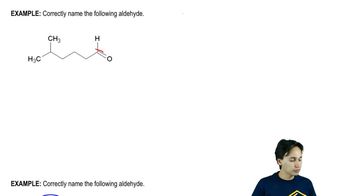
Name the aldehyde

Amine Nucleophilicity

Amines are nucleophiles because they contain a lone pair of electrons on the nitrogen atom, which can attack electrophilic centers such as the carbonyl carbon in aldehydes. The strength of the nucleophilic attack can be influenced by the structure of the amine (primary, secondary, or tertiary) and the reaction conditions, such as the presence of an acid catalyst.
Video consigliato:
07:12
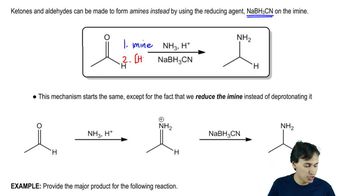
Reductive Amination

Acid-Catalyzed Reactions

In acid-catalyzed reactions, the presence of an acid (H+) can enhance the electrophilicity of the carbonyl carbon in aldehydes, facilitating the nucleophilic attack by amines. The acid can also protonate the amine, increasing its nucleophilicity and promoting the formation of the product, which in this case is likely an imine.
Video consigliato:
03:09
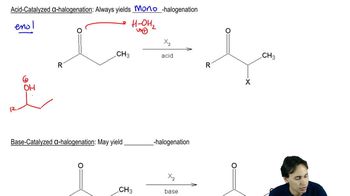
Acid Catalyzed