Ch. 18 - Ketones and Aldehydes
Wade - Organic Chemistry 9th Edition
Wade9th EditionOrganic ChemistryISBN: 9780135213728Non è quello che usi tu?Cambia libro di testo
Capitolo 18, Problema 54a

Predict the products formed when cyclohexanecarbaldehyde reacts with the following reagents.
(a) PhMgBr, then H3O+

Guida verificata passo dopo passo
1
Step 1: Recognize the type of reaction. Cyclohexanecarbaldehyde contains an aldehyde functional group (-CHO). When treated with a Grignard reagent like PhMgBr, the reaction involves nucleophilic addition to the carbonyl group.
Step 2: Analyze the Grignard reagent. PhMgBr consists of a phenyl group (Ph-) bonded to magnesium bromide (MgBr). The phenyl group acts as a nucleophile, attacking the electrophilic carbon of the aldehyde.
Step 3: Write the mechanism for the nucleophilic addition. The phenyl group (Ph-) attacks the carbonyl carbon of cyclohexanecarbaldehyde, breaking the π bond of the carbonyl group. This forms a tetrahedral intermediate with a negatively charged oxygen atom.
Step 4: Consider the second reagent, H3O+. The acidic workup (H3O+) protonates the negatively charged oxygen atom in the intermediate, converting it into a hydroxyl group (-OH). This results in the formation of an alcohol.
Step 5: Predict the final product. The reaction produces a secondary alcohol where the phenyl group (Ph-) is attached to the carbon that was originally part of the aldehyde group in cyclohexanecarbaldehyde.

Risposta video verificata per un problema simile:

Questa soluzione video è stata consigliata dai nostri tutor come utile per risolvere questo problema.
Durata del video:
4m

Concetti chiave

Ecco i concetti essenziali che devi comprendere per rispondere correttamente alla domanda.

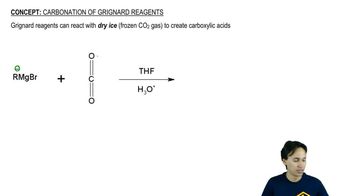
Grignard Reagents

Grignard reagents, such as PhMgBr, are organomagnesium compounds that act as nucleophiles in organic reactions. They readily react with electrophiles, such as carbonyl groups, to form alcohols. In this case, PhMgBr will attack the carbonyl carbon of cyclohexanecarbaldehyde, leading to the formation of a magnesium alkoxide intermediate.
Video consigliato:
02:12
Carbonation of Grignard Reagents

Carbonyl Chemistry

Carbonyl compounds, characterized by a carbon-oxygen double bond, are key functional groups in organic chemistry. They can undergo various reactions, including nucleophilic addition, where nucleophiles attack the electrophilic carbon atom. Understanding the reactivity of carbonyls is crucial for predicting the products of reactions involving aldehydes and ketones.
Video consigliato:
04:20
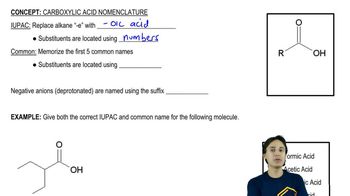
Carboxylic Acids Nomenclature

Acid Workup

An acid workup, typically involving H3O+, is a common step in organic synthesis following nucleophilic addition reactions. This process protonates the alkoxide intermediate formed after the Grignard reaction, converting it into a stable alcohol. The acid workup is essential for isolating the final product and ensuring the reaction reaches completion.
Video consigliato:
01:31
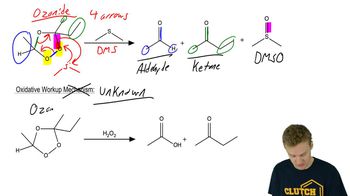
Oxidative Workup Mechanism: