Ch. 18 - Ketones and Aldehydes
Wade - Organic Chemistry 9th Edition
Wade9th EditionOrganic ChemistryISBN: 9780135213728Non è quello che usi tu?Cambia libro di testo
Capitolo 18, Problema 15

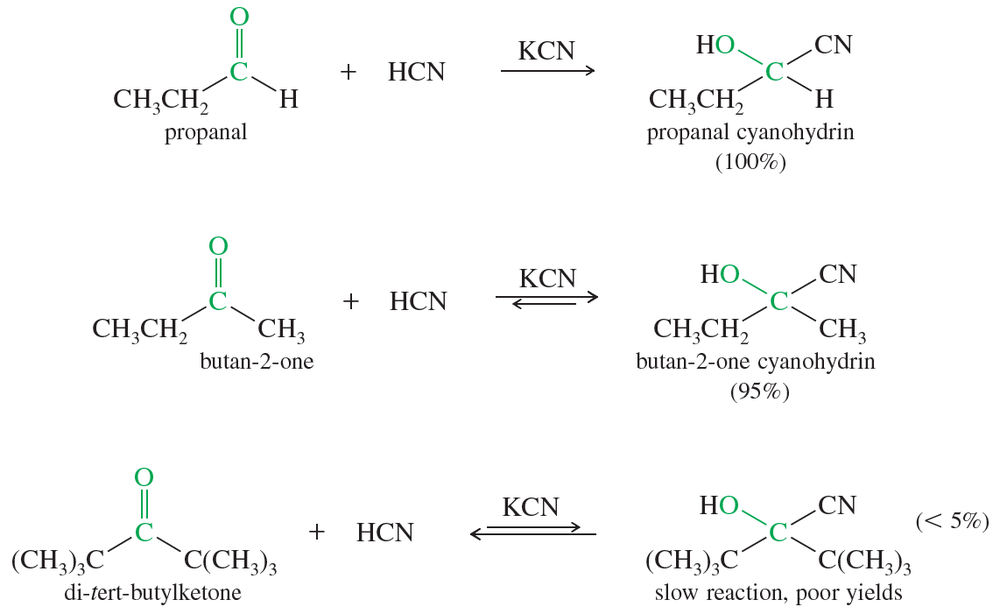
Propose a mechanism for each cyanohydrin synthesis just shown.

Guida verificata passo dopo passo
1
Step 1: Identify the starting material and the reagent. In each case, the starting material is either an aldehyde or a ketone, and the reagent is hydrogen cyanide (HCN). The reaction is catalyzed by cyanide ions (CN⁻).
Step 2: Understand the mechanism. The cyanohydrin synthesis involves nucleophilic addition of the cyanide ion (CN⁻) to the carbonyl group (C=O) of the aldehyde or ketone. This is followed by protonation of the resulting alkoxide intermediate.
Step 3: Initiate the reaction. The cyanide ion (CN⁻) attacks the electrophilic carbon atom of the carbonyl group, breaking the π bond and forming a tetrahedral intermediate. Represent this step as: C1(C=O)+CN-→C1(C-O-CN-)
Step 4: Protonation of the intermediate. The negatively charged oxygen atom in the tetrahedral intermediate is protonated by HCN, forming the cyanohydrin product. Represent this step as: C1(C-O-CN-)+HCN→C1(C-OH-CN-)
Step 5: Analyze the steric and electronic effects. The yield of cyanohydrin depends on the steric hindrance around the carbonyl group. For propanal, the reaction proceeds efficiently due to minimal steric hindrance. For butan-2-one, the yield is slightly lower due to increased steric hindrance. For di-tert-butylketone, the reaction is slow and yields are poor due to significant steric hindrance around the carbonyl group.

Risposta video verificata per un problema simile:

Questa soluzione video è stata consigliata dai nostri tutor come utile per risolvere questo problema.
Durata del video:
2m

Concetti chiave

Ecco i concetti essenziali che devi comprendere per rispondere correttamente alla domanda.

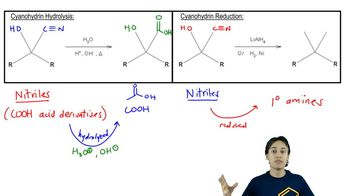
Cyanohydrin Formation

Cyanohydrins are formed through the nucleophilic addition of hydrogen cyanide (HCN) to carbonyl compounds, such as aldehydes or ketones. In this reaction, the nucleophile (cyanide ion) attacks the electrophilic carbon of the carbonyl group, leading to the formation of a hydroxyl group and a cyano group on the same carbon atom.
Video consigliato:
02:36
Nitrile Reduction

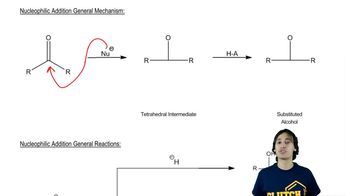
Nucleophilic Addition Mechanism

The nucleophilic addition mechanism involves the attack of a nucleophile on an electrophile, resulting in the formation of a new bond. In the case of cyanohydrin synthesis, the cyanide ion acts as the nucleophile, while the carbonyl carbon serves as the electrophile. This mechanism typically includes a tetrahedral intermediate before the final product is formed.
Video consigliato:
08:27
Nucleophilic Addition

Stereochemistry of Cyanohydrins

Cyanohydrins can exhibit stereochemistry due to the presence of a chiral center formed during their synthesis. The addition of HCN to the carbonyl carbon can lead to the formation of two enantiomers, depending on the orientation of the nucleophile's attack. Understanding the stereochemical implications is crucial for predicting the properties and reactivity of the resulting cyanohydrins.
Video consigliato:
Percorso guidato
1:38
Polymer Stereochemistry Concept 1