Ch. 18 - Ketones and Aldehydes
Wade - Organic Chemistry 9th Edition
Wade9th EditionOrganic ChemistryISBN: 9780135213728Non è quello che usi tu?Cambia libro di testo
Capitolo 18, Problema 50f

Propose mechanisms for the following reactions.
(f)

Guida verificata passo dopo passo
1
Step 1: Analyze the starting material and identify the functional groups. The starting material is a cyclic compound with two methoxy (-OCH3) groups attached to the same carbon atom. This indicates the presence of a geminal dimethoxy group, which is prone to elimination reactions under suitable conditions.
Step 2: Recognize the reagent and its role. The reagent is ethylamine (CH3CH2NH2) in the presence of ethylammonium chloride (CH3CH2NH3+ Cl−). Ethylamine acts as a nucleophile, while ethylammonium chloride provides a mildly acidic environment.
Step 3: Propose the first step of the mechanism. The mildly acidic environment facilitates the protonation of one of the methoxy groups, making it a better leaving group. This leads to the formation of a carbocation intermediate at the carbon where the methoxy groups were attached.
Step 4: Describe the nucleophilic attack. The ethylamine nucleophile attacks the carbocation, forming a bond between the carbon and the nitrogen atom of ethylamine. This results in the formation of an iminium ion intermediate.
Step 5: Finalize the mechanism. The iminium ion undergoes deprotonation to yield the final product, which is a cyclic compound with a double bond between the carbon and nitrogen (C=N) and an ethyl group attached to the nitrogen atom.

Risposta video verificata per un problema simile:

Questa soluzione video è stata consigliata dai nostri tutor come utile per risolvere questo problema.
Durata del video:
7m

Concetti chiave

Ecco i concetti essenziali che devi comprendere per rispondere correttamente alla domanda.

Nucleophilic Substitution Reactions

Nucleophilic substitution reactions involve the replacement of a leaving group in a molecule by a nucleophile. In this context, the amine (CH3CH2NH2) acts as a nucleophile, attacking the electrophilic carbon attached to the leaving group (Cl-) in the starting material. Understanding the mechanism, whether it follows an SN1 or SN2 pathway, is crucial for predicting the outcome of the reaction.
Video consigliato:
01:47
Nucleophiles and Electrophiles can react in Substitution Reactions.

Mechanism of Amine Formation

The formation of amines from alkyl halides typically involves nucleophilic substitution. In this reaction, the amine attacks the carbon atom bonded to the halide, leading to the displacement of the halide ion. This process is essential for synthesizing amines, which are important functional groups in organic chemistry, influencing the reactivity and properties of the resulting compounds.
Video consigliato:
07:12
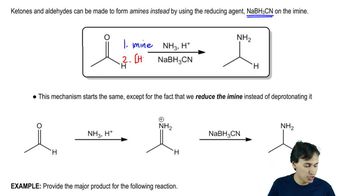
Reductive Amination

Stereochemistry in Reactions

Stereochemistry refers to the spatial arrangement of atoms in molecules and how this affects their chemical behavior. In nucleophilic substitution reactions, the stereochemistry of the reactants can influence the product's configuration. For cyclic compounds, like the one shown, understanding whether the reaction leads to inversion or retention of configuration is vital for predicting the stereochemical outcome of the reaction.
Video consigliato:
Percorso guidato
1:38
Polymer Stereochemistry Concept 1