Ch. 18 - Ketones and Aldehydes
Wade - Organic Chemistry 9th Edition
Wade9th EditionOrganic ChemistryISBN: 9780135213728Non è quello che usi tu?Cambia libro di testo
Capitolo 18, Problema 9a,b

Show how the following transformations may be accomplished in good yield. You may use any additional reagents that are needed.
(a) bromobenzene → propiophenone
(b) CH3CH2CN → heptan-3-one

Guida verificata passo dopo passo
1
For part (a): To convert bromobenzene to propiophenone, first perform a Grignard reaction. React bromobenzene with magnesium (Mg) in dry ether to form phenylmagnesium bromide (a Grignard reagent). This step involves the formation of the Grignard reagent by inserting magnesium into the C-Br bond.
Next, react the phenylmagnesium bromide with propionyl chloride (CH3CH2COCl). This is an acylation reaction where the Grignard reagent attacks the carbonyl carbon of the acyl chloride, forming an intermediate that hydrolyzes to propiophenone upon acidic workup.
For part (b): To convert CH3CH2CN (ethyl cyanide) to heptan-3-one, first perform a Grignard reaction. React CH3CH2CN with a Grignard reagent such as butylmagnesium bromide (C4H9MgBr). The Grignard reagent attacks the carbon of the nitrile group, forming an imine intermediate.
Hydrolyze the imine intermediate under acidic conditions (H3O+) to yield the corresponding ketone, heptan-3-one. This step involves the conversion of the imine to a ketone through hydrolysis.
Ensure proper purification of the products (propiophenone and heptan-3-one) using techniques such as distillation or recrystallization to achieve good yield and purity.

Risposta video verificata per un problema simile:

Questa soluzione video è stata consigliata dai nostri tutor come utile per risolvere questo problema.
Durata del video:
5m

Concetti chiave

Ecco i concetti essenziali che devi comprendere per rispondere correttamente alla domanda.

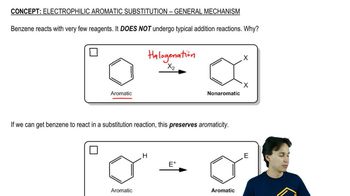
Electrophilic Aromatic Substitution

Electrophilic aromatic substitution (EAS) is a fundamental reaction in organic chemistry where an electrophile replaces a hydrogen atom on an aromatic ring. In the transformation of bromobenzene to propiophenone, EAS is crucial as it allows the introduction of a carbonyl group via acylation, typically using an acyl chloride and a Lewis acid catalyst.
Video consigliato:
03:07
EAS Review

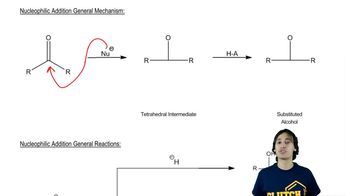
Nucleophilic Addition to Carbonyls

Nucleophilic addition to carbonyls is a key reaction where a nucleophile attacks the electrophilic carbon of a carbonyl group, leading to the formation of alcohols or other functional groups. In the conversion of CH3CH2CN to heptan-3-one, the nitrile group can be hydrolyzed to a carboxylic acid, which can then be converted to a ketone through further reactions, such as reduction and rearrangement.
Video consigliato:
08:27
Nucleophilic Addition

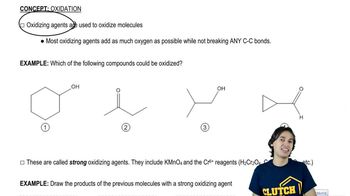
Reagents and Reaction Conditions

The choice of reagents and reaction conditions is critical in organic transformations to achieve good yields. For the transformations mentioned, reagents such as aluminum chloride for EAS and lithium aluminum hydride for the reduction of nitriles are essential. Understanding the reactivity and compatibility of these reagents with the substrates ensures successful synthesis.
Video consigliato:
01:52
Reagents