Ch. 18 - Ketones and Aldehydes
Wade - Organic Chemistry 9th Edition
Wade9th EditionOrganic ChemistryISBN: 9780135213728Non è quello che usi tu?Cambia libro di testo
Capitolo 18, Problema 51e

Show how you would accomplish the following syntheses efficiently and in good yield. You may use any necessary reagents.
(e) Chemical reaction diagram showing the conversion of an aldehyde to a ketone using the Wittig reaction.

Guida verificata passo dopo passo
1
Step 1: Analyze the transformation. The starting material is a cyclopentanone with an aldehyde group at the beta position. The product introduces an ethyl group at the alpha position of the ketone, forming an α,β-unsaturated aldehyde.
Step 2: Perform an α-alkylation reaction. Treat the cyclopentanone with a strong base, such as LDA (lithium diisopropylamide), to generate the enolate ion. This enolate is nucleophilic at the alpha position.
Step 3: Introduce the ethyl group. React the enolate with ethyl bromide (CH3CH2Br) or ethyl iodide (CH3CH2I) in an SN2 reaction to alkylate the alpha position of the ketone.
Step 4: Perform an aldol condensation. Treat the α-ethyl cyclopentanone with a base, such as NaOH or KOH, to form an enolate at the alpha position. This enolate will attack the aldehyde group intramolecularly, forming a β-hydroxy ketone intermediate.
Step 5: Dehydrate the β-hydroxy ketone. Heat the intermediate under acidic or basic conditions to eliminate water and form the α,β-unsaturated aldehyde product.

Risposta video verificata per un problema simile:

Questa soluzione video è stata consigliata dai nostri tutor come utile per risolvere questo problema.
Durata del video:
3m

Concetti chiave

Ecco i concetti essenziali che devi comprendere per rispondere correttamente alla domanda.

Reaction Mechanisms

Understanding reaction mechanisms is crucial in organic chemistry as it describes the step-by-step process by which reactants transform into products. This includes identifying intermediates, transition states, and the role of catalysts. A clear grasp of mechanisms helps predict the outcome of reactions and optimize conditions for better yields.
Video consigliato:
02:16
Heck Reaction Mechanism

Reagents and Conditions

The choice of reagents and reaction conditions significantly influences the efficiency and yield of a synthesis. Different reagents can provide specific functional groups or facilitate particular reaction pathways. Additionally, factors such as temperature, pressure, and solvent can affect reaction rates and selectivity, making it essential to select the right conditions for the desired outcome.
Video consigliato:
01:52
Reagents

Yield and Efficiency

Yield refers to the amount of product obtained from a reaction compared to the theoretical maximum, while efficiency encompasses both yield and the time and resources used. High yield and efficiency are desirable in synthetic chemistry, as they indicate a successful reaction with minimal waste. Understanding how to maximize these factors is key to effective synthesis.
Video consigliato:
04:37
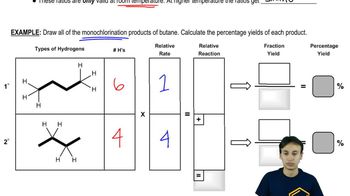
Draw all of the monochlorination products and calculate percentage yields.