Ch. 18 - Ketones and Aldehydes
Wade - Organic Chemistry 9th Edition
Wade9th EditionOrganic ChemistryISBN: 9780135213728Non è quello che usi tu?Cambia libro di testo
Capitolo 18, Problema 47c

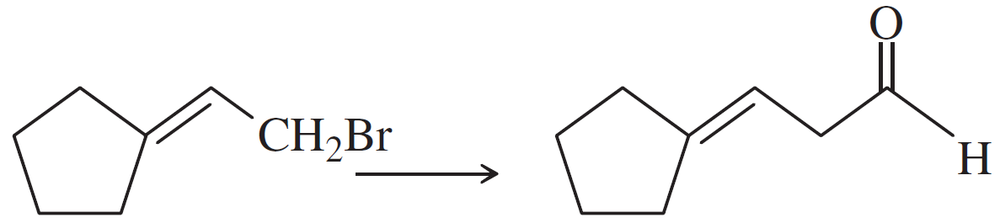
Show how you would accomplish the following synthetic conversions efficiently and in good yield. You may use any necessary additional reagents and solvents.
(c)

Guida verificata passo dopo passo
1
Step 1: Analyze the starting material and product. The starting material is a bromocyclohexane derivative, and the product is a cyclohexane derivative with an aldehyde functional group. This suggests a transformation involving the replacement of the bromine atom with a formyl group (-CHO).
Step 2: Plan the reaction sequence. To achieve this transformation, you can use a two-step process: (1) Convert the alkyl bromide into an alkyl Grignard reagent, and (2) React the Grignard reagent with dimethylformamide (DMF) followed by hydrolysis to introduce the aldehyde group.
Step 3: Perform the first step. Treat the bromocyclohexane derivative with magnesium metal in anhydrous ether to form the Grignard reagent, cyclohexylmagnesium bromide. Ensure the reaction is carried out under inert conditions to prevent moisture from deactivating the Grignard reagent.
Step 4: Perform the second step. React the Grignard reagent with dimethylformamide (DMF). The Grignard reagent will attack the carbonyl carbon of DMF, forming an intermediate that, upon hydrolysis, yields the desired aldehyde.
Step 5: Hydrolyze the intermediate. After the reaction with DMF, perform an acidic workup (e.g., using dilute HCl) to hydrolyze the intermediate and isolate the aldehyde product in good yield.

Risposta video verificata per un problema simile:

Questa soluzione video è stata consigliata dai nostri tutor come utile per risolvere questo problema.
Durata del video:
6m

Concetti chiave

Ecco i concetti essenziali che devi comprendere per rispondere correttamente alla domanda.

DIBAL-H (Diisobutylaluminum Hydride)

DIBAL-H is a selective reducing agent commonly used in organic synthesis to convert esters and nitriles to aldehydes. It operates under mild conditions, allowing for the reduction of functional groups without affecting other sensitive moieties. In the context of the provided reaction, DIBAL-H can effectively reduce a brominated compound to an aldehyde by first forming an intermediate that can be further processed.
Video consigliato:
02:10
DIBAL-H on Esters and Nitriles

Nucleophilic Substitution

Nucleophilic substitution is a fundamental reaction mechanism in organic chemistry where a nucleophile attacks an electrophile, resulting in the replacement of a leaving group. In this case, the bromine atom acts as a leaving group, allowing the nucleophile to take its place. Understanding this mechanism is crucial for predicting the outcome of reactions involving halogenated compounds.
Video consigliato:
01:47
Nucleophiles and Electrophiles can react in Substitution Reactions.

Functional Group Transformation

Functional group transformation refers to the process of converting one functional group into another through chemical reactions. In the given question, the transformation of a brominated compound to an aldehyde exemplifies this concept. Mastery of various transformation techniques is essential for synthetic organic chemistry, as it allows chemists to design and execute complex synthetic pathways.
Video consigliato:
02:36
Identifying Functional Groups