Ch. 18 - Ketones and Aldehydes
Wade - Organic Chemistry 9th Edition
Wade9th EditionOrganic ChemistryISBN: 9780135213728Non è quello che usi tu?Cambia libro di testo
Capitolo 18, Problema 7c

Show how you would accomplish the following synthetic
conversions by adding an organolithium reagent to an acid.
(c) pentanoic acid → heptan-3-one

Guida verificata passo dopo passo
1
Step 1: Understand the reaction mechanism. Organolithium reagents are strong nucleophiles and bases. When added to a carboxylic acid, they first deprotonate the acid to form a carboxylate anion. This step is crucial for the subsequent reaction steps.
Step 2: For part (c), pentanoic acid → heptan-3-one: Add an organolithium reagent, such as propyl lithium (C3H7Li), to pentanoic acid. The carboxylic acid will be deprotonated to form pentanoate anion, and the organolithium reagent will act as a nucleophile in subsequent steps.
Step 3: After forming the carboxylate anion, react it with an electrophile, such as propyl bromide (C3H7Br), to introduce the propyl group. This step involves nucleophilic substitution, leading to the formation of an intermediate ketone.
Step 4: For part (d), phenylacetic acid → 3,3-dimethyl-1-phenylbutan-2-one: Add an organolithium reagent, such as tert-butyl lithium ((CH3)3CLi), to phenylacetic acid. The acid will be deprotonated to form phenylacetate anion, and the organolithium reagent will act as a nucleophile.
Step 5: React the phenylacetate anion with an appropriate electrophile, such as tert-butyl bromide ((CH3)3CBr), to introduce the tert-butyl group. This step involves nucleophilic substitution, leading to the formation of the desired ketone product.

Risposta video verificata per un problema simile:

Questa soluzione video è stata consigliata dai nostri tutor come utile per risolvere questo problema.
Durata del video:
5m

Concetti chiave

Ecco i concetti essenziali che devi comprendere per rispondere correttamente alla domanda.

Organolithium Reagents

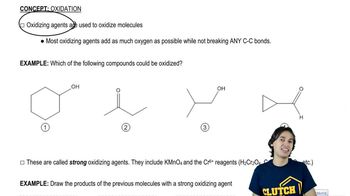
Organolithium reagents are highly reactive compounds containing a carbon-lithium bond. They act as strong nucleophiles and are commonly used in organic synthesis to form carbon-carbon bonds. When added to carbonyl compounds or acids, they can facilitate the formation of new carbon chains, making them essential for various synthetic transformations.
Video consigliato:
01:52
Reagents

Carboxylic Acid Reactivity

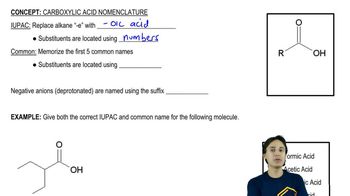
Carboxylic acids are organic compounds characterized by the presence of a carboxyl group (-COOH). They can undergo nucleophilic acyl substitution reactions, where nucleophiles, such as organolithium reagents, attack the carbonyl carbon. This reactivity is crucial for converting carboxylic acids into more complex molecules, such as ketones or alcohols.
Video consigliato:
04:20
Carboxylic Acids Nomenclature

Synthetic Pathways

Synthetic pathways refer to the series of chemical reactions that transform starting materials into desired products. Understanding these pathways is vital for planning synthetic routes in organic chemistry. In the context of the given conversions, identifying the correct sequence of reactions involving organolithium reagents and carboxylic acids is essential for achieving the target compounds.
Video consigliato:
Percorso guidato
2:13
Energy Production In Biochemical Pathways Concept 1