Ch. 18 - Ketones and Aldehydes
Wade - Organic Chemistry 9th Edition
Wade9th EditionOrganic ChemistryISBN: 9780135213728Non è quello che usi tu?Cambia libro di testo
Capitolo 18, Problema 55f

Show how you would synthesize octan-2-one from each compound. You may use any necessary reagents.
(f) CH3(CH2)5CN

Guida verificata passo dopo passo
1
Step 1: Begin by hydrolyzing the nitrile group (-CN) in CH3(CH2)5CN to convert it into a carboxylic acid. Use acidic or basic hydrolysis conditions, such as H3O+ (acidic) or NaOH followed by acidification. This will yield CH3(CH2)5COOH.
Step 2: Convert the carboxylic acid (CH3(CH2)5COOH) into an acid chloride (CH3(CH2)5COCl) using a reagent like thionyl chloride (SOCl2). This step activates the carboxylic acid for further reactions.
Step 3: Perform a Friedel-Crafts acylation reaction to introduce the ketone functionality. React the acid chloride (CH3(CH2)5COCl) with ethane (CH3CH3) in the presence of a Lewis acid catalyst, such as AlCl3. This will yield octan-2-one.
Step 4: Purify the product octan-2-one using techniques like distillation or chromatography to ensure the desired compound is isolated.
Step 5: Confirm the structure of octan-2-one using spectroscopic methods such as IR (to check for the carbonyl group) and NMR (to verify the positions of the protons and carbons).

Risposta video verificata per un problema simile:

Questa soluzione video è stata consigliata dai nostri tutor come utile per risolvere questo problema.
Durata del video:
3m

Concetti chiave

Ecco i concetti essenziali che devi comprendere per rispondere correttamente alla domanda.

Nitrile Chemistry

Nitriles, such as CH3(CH2)5CN, can be converted into ketones through hydrolysis. This process involves the addition of water in the presence of an acid or base, leading to the formation of a carboxylic acid, which can then be further reduced to yield the corresponding ketone. Understanding the reactivity of nitriles is crucial for synthesizing octan-2-one from this starting material.
Video consigliato:
01:01
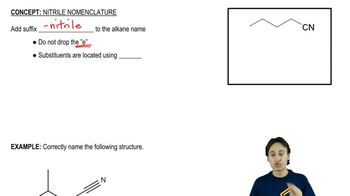
Nitrile Nomenclature

Reduction Reactions

Reduction reactions are essential in organic synthesis, where a compound gains electrons or hydrogen, often resulting in the formation of alcohols or ketones. In the context of synthesizing octan-2-one, the reduction of a carboxylic acid derived from the nitrile can be achieved using reagents like lithium aluminum hydride (LiAlH4) or sodium borohydride (NaBH4), which convert the acid to the desired ketone.
Video consigliato:
07:12
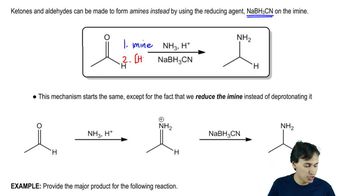
Reductive Amination

Synthesis Pathways

Synthesis pathways refer to the step-by-step methods used to convert starting materials into target compounds. For octan-2-one, a clear pathway from CH3(CH2)5CN involves hydrolysis to form a carboxylic acid followed by reduction to the ketone. Understanding these pathways allows chemists to design efficient and effective routes for synthesizing complex organic molecules.
Video consigliato:
Percorso guidato
2:13
Energy Production In Biochemical Pathways Concept 1