Ch. 18 - Ketones and Aldehydes
Wade - Organic Chemistry 9th Edition
Wade9th EditionOrganic ChemistryISBN: 9780135213728Non è quello che usi tu?Cambia libro di testo
Capitolo 18, Problema 55a

Show how you would synthesize octan-2-one from each compound. You may use any necessary reagents.
(a) heptanal

Guida verificata passo dopo passo
1
Identify the target molecule (octan-2-one) and analyze its structure. It is a ketone with the carbonyl group on the second carbon of an eight-carbon chain.
Examine the starting material (heptanal). Heptanal is an aldehyde with a seven-carbon chain. To synthesize octan-2-one, you need to add one carbon to the chain and convert the aldehyde into a ketone.
Add one carbon to the chain by performing a Grignard reaction. React heptanal with methylmagnesium bromide (CH₃MgBr) to form a secondary alcohol. This reaction involves nucleophilic addition of the methyl group to the carbonyl carbon of heptanal.
Oxidize the secondary alcohol formed in the previous step to a ketone. Use an oxidizing agent such as PCC (pyridinium chlorochromate) or Jones reagent (CrO₃/H₂SO₄) to achieve this transformation.
Verify the structure of the product to ensure it matches octan-2-one. The carbonyl group should now be on the second carbon of the eight-carbon chain, completing the synthesis.

Risposta video verificata per un problema simile:

Questa soluzione video è stata consigliata dai nostri tutor come utile per risolvere questo problema.
Durata del video:
7m

Concetti chiave

Ecco i concetti essenziali che devi comprendere per rispondere correttamente alla domanda.

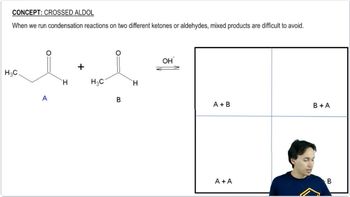
Aldol Condensation

Aldol condensation is a reaction between aldehydes or ketones that contain alpha-hydrogens, leading to the formation of β-hydroxy aldehydes or ketones. This reaction is crucial for synthesizing larger carbon chains, as it allows for the formation of new carbon-carbon bonds. In the case of heptanal, an aldol condensation can be performed to create a compound that can be further transformed into octan-2-one.
Video consigliato:
09:51
Crossed Aldol

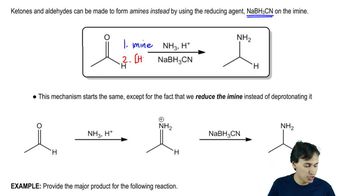
Reduction Reactions

Reduction reactions involve the gain of electrons or hydrogen, or the loss of oxygen, resulting in the conversion of carbonyl compounds into alcohols or other functional groups. In synthesizing octan-2-one from heptanal, reduction can be employed to convert an intermediate compound into the desired ketone. Common reducing agents include lithium aluminum hydride (LiAlH4) or sodium borohydride (NaBH4).
Video consigliato:
07:12
Reductive Amination

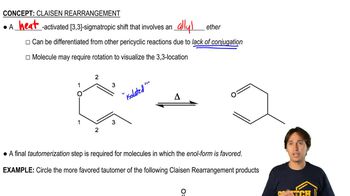
Rearrangement Reactions

Rearrangement reactions involve the structural reorganization of a molecule, often leading to the formation of more stable or functionalized products. In the synthesis of octan-2-one from heptanal, a rearrangement may be necessary to shift the position of the carbonyl group or to create the desired ketone structure. This concept is essential for understanding how to manipulate molecular structures during synthesis.
Video consigliato:
06:08
Definition of Claisen Rearrangement