
Ch. 18 - Ketones and Aldehydes
Wade - Organic Chemistry 9th Edition
Wade9th EditionOrganic ChemistryISBN: 9780135213728Non è quello che usi tu?Cambia libro di testo
Capitolo 18, Problema 26a,b,c

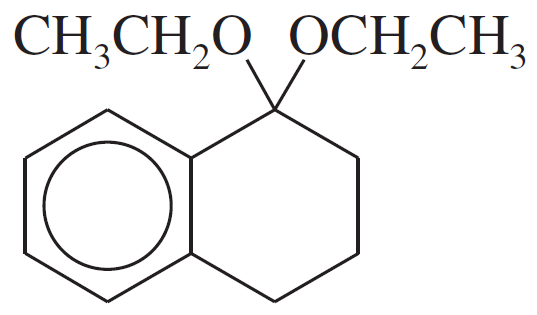
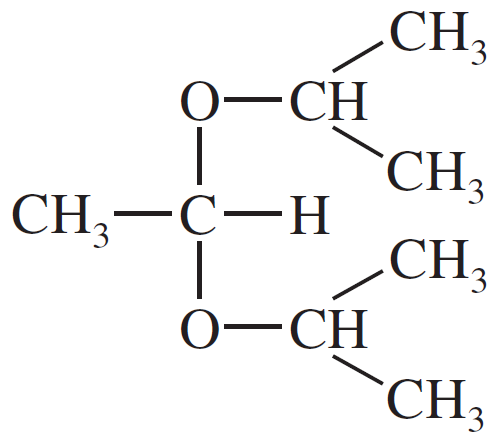
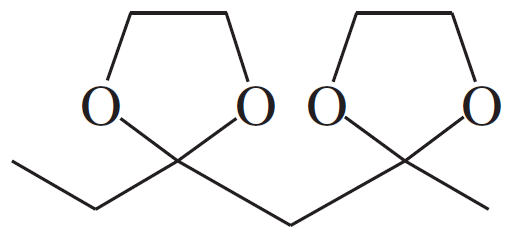
Show what alcohols and carbonyl compounds give the following derivatives.
(a)
(b)
(c)

Guida verificata passo dopo passo
1
Step 1: Analyze the derivative structures provided in the images. Each derivative corresponds to a reaction between an alcohol and a carbonyl compound. For (a), the structure shows a cyclic acetal formed from a cyclopentane ring with two methoxy groups attached to the same carbon. For (b), the structure shows a ketal with three isopropyl groups attached to two oxygen atoms. For (c), the structure shows a cyclic acetal formed from a cyclohexane ring with two oxygen atoms connected to two additional cyclic structures.
Step 2: Recall the general mechanism for acetal and ketal formation. Acetals and ketals are formed when alcohols react with aldehydes or ketones in the presence of an acid catalyst. The reaction involves nucleophilic attack of the alcohol on the carbonyl carbon, followed by dehydration to form the acetal or ketal.
Step 3: For derivative (a), identify the alcohol and carbonyl compound. The cyclic acetal suggests that the alcohol used is methanol (CH₃OH), and the carbonyl compound is cyclopentanone (a ketone with a five-membered ring). The reaction forms the acetal by adding two methoxy groups to the carbonyl carbon.
Step 4: For derivative (b), identify the alcohol and carbonyl compound. The ketal structure suggests that the alcohol used is isopropanol ((CH₃)₂CHOH), and the carbonyl compound is acetone ((CH₃)₂CO). The reaction forms the ketal by adding two isopropoxy groups to the carbonyl carbon.
Step 5: For derivative (c), identify the alcohol and carbonyl compound. The cyclic acetal structure suggests that the alcohol used is ethylene glycol (HOCH₂CH₂OH), and the carbonyl compound is cyclohexanone (a ketone with a six-membered ring). The reaction forms the acetal by connecting the two hydroxyl groups of ethylene glycol to the carbonyl carbon.

Risposta video verificata per un problema simile:

Questa soluzione video è stata consigliata dai nostri tutor come utile per risolvere questo problema.
Durata del video:
7m

Concetti chiave

Ecco i concetti essenziali che devi comprendere per rispondere correttamente alla domanda.

Alcohols

Alcohols are organic compounds characterized by the presence of one or more hydroxyl (-OH) groups attached to a carbon atom. They can undergo various reactions, including dehydration to form alkenes or oxidation to yield carbonyl compounds. Understanding the structure and reactivity of alcohols is crucial for predicting the types of derivatives they can form, such as ethers or esters.
Video consigliato:
01:01
How to name alcohols

Carbonyl Compounds

Carbonyl compounds, which include aldehydes and ketones, contain a carbon atom double-bonded to an oxygen atom (C=O). These compounds are highly reactive and can participate in nucleophilic addition reactions, leading to the formation of various derivatives like imines and enamines. Recognizing the structure and reactivity of carbonyl compounds is essential for understanding their derivatives.
Video consigliato:
01:40
Defining meso compounds.

Imines and Enamines

Imines and enamines are derivatives formed from carbonyl compounds. Imines are produced when a carbonyl compound reacts with an amine, resulting in a C=N bond, while enamines are formed when a carbonyl compound reacts with a secondary amine, leading to a C=C bond adjacent to a nitrogen atom. These derivatives are important in organic synthesis and can serve as intermediates in various chemical reactions.
Video consigliato:
06:25
Enamine Mechanism