Ch. 18 - Ketones and Aldehydes
Wade - Organic Chemistry 9th Edition
Wade9th EditionOrganic ChemistryISBN: 9780135213728Non è quello che usi tu?Cambia libro di testo
Capitolo 18, Problema 3

Why were no products from the McLafferty rearrangement observed in the spectrum of butan-2-one (Figure 18-3)?
<IMAGE>

Guida verificata passo dopo passo
1
Understand the McLafferty rearrangement: This is a fragmentation process observed in mass spectrometry, where a molecule undergoes a specific cleavage involving a γ-hydrogen (a hydrogen atom three carbons away from a carbonyl group) and the carbonyl group. This results in the formation of a neutral alkene and a charged fragment.
Analyze the structure of butan-2-one: The molecular structure of butan-2-one is CH₃-CO-CH₂-CH₃. Identify the γ-hydrogens relative to the carbonyl group (C=O).
Determine the presence of γ-hydrogens: In butan-2-one, the γ-hydrogens would be located on the terminal methyl groups (CH₃). However, for a McLafferty rearrangement to occur, there must be a γ-hydrogen that can participate in a six-membered cyclic transition state.
Evaluate the feasibility of the six-membered transition state: In butan-2-one, the γ-hydrogens are not positioned in a way that allows the formation of a six-membered cyclic transition state. This is because the molecule lacks the necessary spatial arrangement for the rearrangement to occur.
Conclude why no McLafferty products are observed: Since the structural requirements for the McLafferty rearrangement are not met in butan-2-one, no products from this rearrangement are observed in its mass spectrum.

Risposta video verificata per un problema simile:

Questa soluzione video è stata consigliata dai nostri tutor come utile per risolvere questo problema.
Durata del video:
3m

Concetti chiave

Ecco i concetti essenziali che devi comprendere per rispondere correttamente alla domanda.

McLafferty Rearrangement

The McLafferty rearrangement is a fragmentation process observed in mass spectrometry, where a molecule undergoes a rearrangement to form a more stable product. This typically involves the transfer of a hydrogen atom and the formation of a double bond, resulting in the cleavage of a carbon-carbon bond. It is most commonly seen in compounds with a gamma-hydrogen, which is crucial for the rearrangement to occur.
Video consigliato:
06:08
Definition of Claisen Rearrangement

Mass Spectrometry

Mass spectrometry is an analytical technique used to measure the mass-to-charge ratio of ions. It provides information about the molecular weight and structure of compounds by ionizing chemical species and sorting the resulting ions based on their mass. The resulting spectrum displays peaks corresponding to different ions, allowing for the identification of molecular fragments and the analysis of complex mixtures.
Video consigliato:
01:25
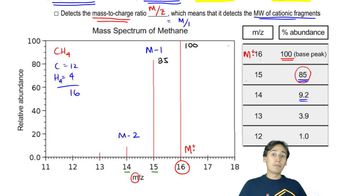
How to Read a Mass Spectrum

Structural Features of Butan-2-one

Butan-2-one, a ketone, has a specific structure that lacks a gamma-hydrogen atom necessary for the McLafferty rearrangement to occur. The absence of this hydrogen means that the molecule cannot undergo the rearrangement process, leading to the absence of expected products in the mass spectrum. Understanding the structural features of organic compounds is essential for predicting their behavior in mass spectrometry.
Video consigliato:
Percorso guidato
1:09
Secondary Protein Structure Example 4