Ch. 18 - Ketones and Aldehydes
Wade - Organic Chemistry 9th Edition
Wade9th EditionOrganic ChemistryISBN: 9780135213728Non è quello che usi tu?Cambia libro di testo
Capitolo 18, Problema 30a

Write the sequence of steps required for the conversion of benzene into benzenediazonium chloride.

Guida verificata passo dopo passo
1
Step 1: Begin with benzene (C₆H₆) as the starting material. Perform nitration of benzene by reacting it with concentrated nitric acid (HNO₃) and concentrated sulfuric acid (H₂SO₄) as a catalyst. This introduces a nitro group (-NO₂) onto the benzene ring, forming nitrobenzene (C₆H₅NO₂).
Step 2: Reduce the nitro group (-NO₂) in nitrobenzene to an amino group (-NH₂). This can be achieved by catalytic hydrogenation (using H₂ gas and a metal catalyst like Pd/C) or by chemical reduction using tin (Sn) and hydrochloric acid (HCl). The product is aniline (C₆H₅NH₂).
Step 3: Prepare a solution of sodium nitrite (NaNO₂) in water and cool it to 0-5°C. This is necessary to generate nitrous acid (HNO₂) in situ, which is unstable and decomposes at higher temperatures.
Step 4: React aniline (C₆H₅NH₂) with the freshly prepared nitrous acid (HNO₂) in the presence of hydrochloric acid (HCl) at 0-5°C. This reaction is called diazotization and results in the formation of benzenediazonium chloride (C₆H₅N₂⁺Cl⁻).
Step 5: Ensure the reaction mixture is kept cold (0-5°C) throughout the diazotization process to stabilize the benzenediazonium chloride, as it is prone to decomposition at higher temperatures.

Risposta video verificata per un problema simile:

Questa soluzione video è stata consigliata dai nostri tutor come utile per risolvere questo problema.
Durata del video:
6m

Concetti chiave

Ecco i concetti essenziali che devi comprendere per rispondere correttamente alla domanda.

Electrophilic Aromatic Substitution

Electrophilic aromatic substitution (EAS) is a fundamental reaction in organic chemistry where an electrophile replaces a hydrogen atom on an aromatic ring. This process is crucial for modifying benzene derivatives, as it allows for the introduction of various functional groups. In the case of converting benzene to benzenediazonium chloride, the first step involves the nitration of benzene to form nitrobenzene, which is then further processed.
Video consigliato:
03:07
EAS Review

Nitration of Benzene

Nitration is the process of introducing a nitro group (-NO2) into an aromatic compound, typically using a mixture of concentrated nitric acid and sulfuric acid. This reaction is an example of electrophilic aromatic substitution, where the nitronium ion (NO2+) acts as the electrophile. The formation of nitrobenzene from benzene is a critical step in the synthesis of benzenediazonium chloride, as it sets the stage for subsequent reactions.
Video consigliato:
09:04
Benzene Nomenclature

Diazotization

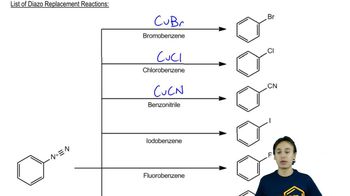
Diazotization is the conversion of primary aromatic amines into diazonium salts, which are highly reactive intermediates in organic synthesis. This process typically involves treating an amine with nitrous acid (generated in situ from sodium nitrite and a mineral acid) at low temperatures. For the conversion of nitrobenzene to benzenediazonium chloride, the nitro group is first reduced to an amine, which is then diazotized to form the desired diazonium compound.
Video consigliato:
06:59
Replacement Reactions
Pratica correlata
Domanda del libro di testo

Show how you would accomplish the following syntheses. You may use whatever additional reagents you need.

(e)

549
views

Domanda del libro di testo

Like other strong nucleophiles, triphenylphosphine attacks and opens epoxides. The initial product (a betaine) quickly cyclizes to an oxaphosphetane that collapses to an alkene and triphenylphosphine oxide.

(b) Show how this sequence might be used to convert cis-cyclooctene to trans-cyclooctene.

526
views
Domanda del libro di testo

Show how you would accomplish the following syntheses. You may use whatever additional reagents you need.

(f)

672
views
Domanda del libro di testo

Trimethylphosphine is a stronger nucleophile than triphenylphosphine, but it is rarely used to make ylides. Why is trimethylphosphine unsuitable for making most phosphorus ylides?

1192
views
Domanda del libro di testo

(a) Outline the syntheses indicated in Solved Problem 18-2, beginning with aldehydes and alkyl halides.

(b) Both of these syntheses of 1-phenylbuta-1,3-diene form the central double bond. Show how you would synthesize this target molecule by forming the terminal double bond.

1530
views
Domanda del libro di testo

Like other strong nucleophiles, triphenylphosphine attacks and opens epoxides. The initial product (a betaine) quickly cyclizes to an oxaphosphetane that collapses to an alkene and triphenylphosphine oxide.

(a) Show each step in the reaction of trans-2,3-epoxybutane with triphenylphosphine to give but-2-ene. What is the stereochemistry of the double bond in the product?

920
views