Ch. 19 - Amines
Wade - Organic Chemistry 9th Edition
Wade9th EditionOrganic ChemistryISBN: 9780135213728Non è quello che usi tu?Cambia libro di testo
Capitolo 19, Problema 60c

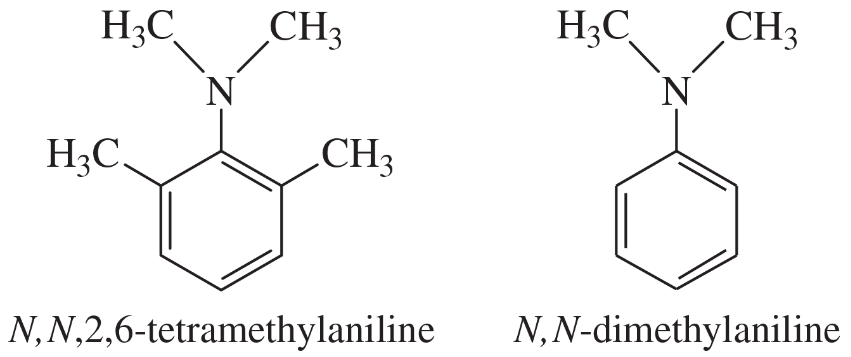
Explain why N,N,2,6-tetramethylaniline (shown) is a much stronger base than N,N-dimethylaniline.

Guida verificata passo dopo passo
1
Step 1: Begin by analyzing the structures of N,N,2,6-tetramethylaniline and N,N-dimethylaniline. Both molecules contain a nitrogen atom bonded to two methyl groups, but N,N,2,6-tetramethylaniline has additional methyl groups at the ortho positions (2 and 6) of the benzene ring.
Step 2: Understand the concept of basicity in amines. The basicity of an amine is determined by the availability of the lone pair of electrons on the nitrogen atom to accept a proton (H⁺). Factors that influence this availability include steric hindrance and electronic effects.
Step 3: Examine the steric effects in N,N,2,6-tetramethylaniline. The methyl groups at the ortho positions create steric hindrance, which prevents the nitrogen's lone pair from interacting effectively with the π-electrons of the benzene ring. This steric hindrance reduces conjugation between the nitrogen and the benzene ring, making the lone pair more available for protonation.
Step 4: Compare this to N,N-dimethylaniline. In this molecule, there are no ortho substituents, so the nitrogen's lone pair can delocalize into the benzene ring through resonance. This delocalization reduces the availability of the lone pair for protonation, making N,N-dimethylaniline a weaker base.
Step 5: Conclude that the steric hindrance caused by the ortho methyl groups in N,N,2,6-tetramethylaniline prevents resonance delocalization of the nitrogen's lone pair, increasing its basicity compared to N,N-dimethylaniline.

Risposta video verificata per un problema simile:

Questa soluzione video è stata consigliata dai nostri tutor come utile per risolvere questo problema.
Durata del video:
7m

Concetti chiave

Ecco i concetti essenziali che devi comprendere per rispondere correttamente alla domanda.

Basicity in Organic Chemistry

Basicity refers to the ability of a compound to accept protons (H+ ions). In organic chemistry, the strength of a base is influenced by the availability of its lone pair of electrons to bond with protons. Stronger bases have more available electron density, which allows them to more readily accept protons.
Video consigliato:
00:56
What is an organic molecule?

Steric Hindrance

Steric hindrance occurs when the spatial arrangement of atoms in a molecule prevents certain interactions, such as protonation. In the case of N,N,2,6-tetramethylaniline, the presence of bulky methyl groups at the 2 and 6 positions creates a more favorable environment for the nitrogen's lone pair to interact with protons, enhancing its basicity compared to N,N-dimethylaniline, which has less steric bulk.
Video consigliato:
02:53
Understanding steric effects.

Electron-Donating Groups

Electron-donating groups, such as alkyl groups, increase the electron density on the nitrogen atom in amines, enhancing their basicity. In N,N,2,6-tetramethylaniline, the four methyl groups significantly increase the electron density on the nitrogen, making it a stronger base than N,N-dimethylaniline, which has only two methyl groups contributing to electron donation.
Video consigliato:
02:37
Donating vs Withdrawing Groups
Pratica correlata
Domanda del libro di testo

Basicity depends on availability of an electron pair to bond a proton. Correlate structural effects in these amines with their basicities.

(a) Explain this order:

849
views

Domanda del libro di testo

Basicity depends on availability of an electron pair to bond a proton. Correlate structural effects in these amines with their basicities.

(b) Explain:

812
views
Domanda del libro di testo

Basicity depends on availability of an electron pair to bond a proton. Correlate structural effects in these amines with their basicities.

(c) The pKb of this compound is −2.3, making it not only a stronger base than a typical aniline, but even stronger than hydroxide ion. Explain its remarkable basicity.

557
views
Domanda del libro di testo

The following spectra for A and B correspond to two structural isomers. The NMR singlet at δ1.16 in spectrum A disappears when the sample is shaken with D2O. The singlet at δ0.6 ppm in the spectrum of B disappears on shaking with D2O. Propose structures for these isomers, and show how your structures correspond to the spectra. Show what cleavage is responsible for the base peak at m/z 44 in the mass spectrum of A and the prominent peak at m/z 58 in the mass spectrum of B.

<IMAGE>

1583
views
Domanda del libro di testo

Show why p-nitroaniline is a much weaker base (3 pKb units weaker) than aniline.

1168
views
Domanda del libro di testo

Guanidine (shown) is about as strong a base as hydroxide ion. Explain why guanidine is a much stronger base than most other amines.

1178
views