Ch. 19 - Amines
Wade - Organic Chemistry 9th Edition
Wade9th EditionOrganic ChemistryISBN: 9780135213728Non è quello che usi tu?Cambia libro di testo
Capitolo 19, Problema 38a

Predict the products of the following reactions:
(a) excess NH3 + Ph–CH2CH2CH2Br →

Guida verificata passo dopo passo
1
Step 1: Recognize the type of reaction. This is a nucleophilic substitution reaction where ammonia (NH₃) acts as the nucleophile and the alkyl bromide (Ph-CH₂CH₂CH₂Br) is the electrophile.
Step 2: Identify the mechanism. Since the alkyl bromide is a primary alkyl halide, the reaction will likely proceed via an SN2 mechanism, where the nucleophile attacks the carbon attached to the bromine, displacing the bromine atom.
Step 3: Write the first substitution step. Ammonia (NH₃) will attack the carbon bonded to the bromine, forming a new bond between the carbon and the nitrogen. This results in the formation of a primary amine (Ph-CH₂CH₂CH₂-NH₂) and the release of bromide ion (Br⁻).
Step 4: Consider the effect of excess NH₃. Since excess ammonia is present, the primary amine product can further react with another molecule of alkyl bromide, leading to the formation of a secondary amine (Ph-CH₂CH₂CH₂-NH-CH₂CH₂CH₂Ph) and so on. This process can continue to form tertiary amines or even quaternary ammonium salts.
Step 5: Summarize the possible products. Depending on the reaction conditions and the amount of excess NH₃, the products can include a primary amine, secondary amine, tertiary amine, or quaternary ammonium salt. The reaction can be controlled to favor specific products by adjusting the stoichiometry and reaction conditions.

Risposta video verificata per un problema simile:

Questa soluzione video è stata consigliata dai nostri tutor come utile per risolvere questo problema.
Durata del video:
2m

Concetti chiave

Ecco i concetti essenziali che devi comprendere per rispondere correttamente alla domanda.

Nucleophilic Substitution

Nucleophilic substitution is a fundamental reaction in organic chemistry where a nucleophile attacks an electrophile, resulting in the replacement of a leaving group. In this case, the bromine atom in Ph-CH2CH2CH2Br acts as the leaving group, while ammonia (NH3) serves as the nucleophile. Understanding this mechanism is crucial for predicting the products of the reaction.
Video consigliato:
01:47
Nucleophiles and Electrophiles can react in Substitution Reactions.

Amine Formation

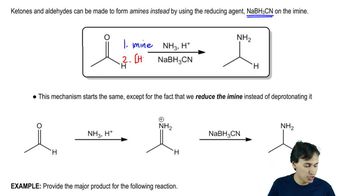
The reaction of ammonia with alkyl halides typically leads to the formation of amines. In this scenario, the nucleophilic attack by NH3 on the carbon attached to the bromine results in the formation of a primary amine. Recognizing the type of amine produced is essential for accurately predicting the final products of the reaction.
Video consigliato:
07:12
Reductive Amination

Excess Reagent Effects

Using an excess of a reagent, such as ammonia in this reaction, can influence the outcome by driving the reaction to completion and potentially leading to further reactions. In this case, excess NH3 can lead to the formation of multiple amine products, including secondary and tertiary amines, if the reaction conditions allow for further substitution. Understanding the implications of using excess reagents is vital for predicting all possible products.
Video consigliato:
04:21
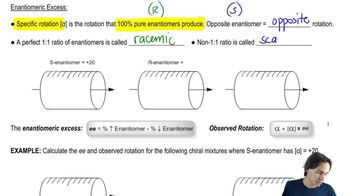
How to calculate enantiomeric excess.