Ch. 19 - Amines
Wade - Organic Chemistry 9th Edition
Wade9th EditionOrganic ChemistryISBN: 9780135213728Non è quello che usi tu?Cambia libro di testo
Capitolo 19, Problema 46b

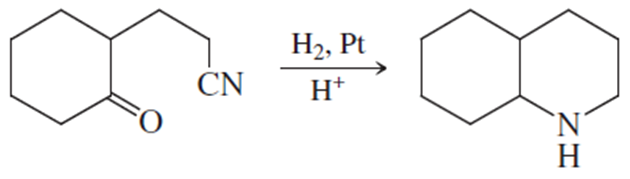
Propose mechanisms for the following reactions.
(b)

Guida verificata passo dopo passo
1
Step 1: Analyze the starting material and product. The starting material is a ketone with a cyano group (-CN) attached to a cyclohexane ring. The product is a secondary amine in a bicyclic structure. This suggests a reduction and cyclization mechanism.
Step 2: Recognize the reagents used. The reaction involves H2 gas, a platinum (Pt) catalyst, and acidic conditions (H+). These conditions are typical for catalytic hydrogenation, which reduces functional groups such as ketones and nitriles.
Step 3: Propose the reduction of the cyano group (-CN). Under hydrogenation conditions, the cyano group is reduced to a primary amine (-CH2NH2). This step involves the addition of hydrogen atoms to the carbon and nitrogen of the cyano group.
Step 4: Propose the reduction of the ketone group. The ketone is reduced to a secondary alcohol (-CH(OH)-) via hydrogenation. This step involves the addition of hydrogen atoms to the carbonyl carbon and oxygen.
Step 5: Propose the cyclization mechanism. Under acidic conditions, the primary amine (-CH2NH2) can attack the secondary alcohol (-CH(OH)-) in an intramolecular nucleophilic substitution reaction. This leads to the formation of a bicyclic structure with a secondary amine (-NH-) as the final product.

Risposta video verificata per un problema simile:

Questa soluzione video è stata consigliata dai nostri tutor come utile per risolvere questo problema.
Durata del video:
9m

Concetti chiave

Ecco i concetti essenziali che devi comprendere per rispondere correttamente alla domanda.

Reaction Mechanisms

A reaction mechanism is a step-by-step description of how a chemical reaction occurs at the molecular level. It outlines the sequence of elementary steps, including bond breaking and formation, and the intermediates formed during the reaction. Understanding mechanisms is crucial for predicting the products and understanding the kinetics and thermodynamics of the reaction.
Video consigliato:
02:16
Heck Reaction Mechanism

Types of Organic Reactions

Organic reactions can be classified into several types, including substitution, addition, elimination, and rearrangement reactions. Each type has distinct characteristics and mechanisms. Recognizing the type of reaction helps in predicting the behavior of reactants and the nature of the products formed, which is essential for proposing accurate mechanisms.
Video consigliato:
07:37
Properties and Types of Pericyclic Reactions

Curved Arrow Notation

Curved arrow notation is a visual representation used in organic chemistry to illustrate the movement of electrons during chemical reactions. Arrows indicate the direction of electron flow, showing how bonds are broken and formed. Mastery of this notation is vital for accurately depicting reaction mechanisms and understanding the underlying processes in organic reactions.
Video consigliato:
06:20
Alternative MO Notation for Dienes