
Ch. 19 - Amines
Wade - Organic Chemistry 9th Edition
Wade9th EditionOrganic ChemistryISBN: 9780135213728Non è quello che usi tu?Cambia libro di testo
Capitolo 19, Problema 48c

Several additional amine syntheses are effectively limited to making primary amines. The reduction of azides and nitro compounds and the Gabriel synthesis leave the carbon chain unchanged. Formation and reduction of a nitrile adds one carbon atom. Show how these amine syntheses can be used for the following conversions.
(c) 1-bromo-3-phenylheptane → 3-phenylheptan-1-amine

Guida verificata passo dopo passo
1
Step 1: Recognize that the target molecule is a primary amine (3-phenylheptan-1-amine) and the starting material is 1-bromo-3-phenylheptane. This suggests that the synthesis will involve replacing the bromine atom with an amine group.
Step 2: Use the formation of a nitrile to add the amine group. Treat 1-bromo-3-phenylheptane with potassium cyanide (KCN) in an appropriate solvent (e.g., ethanol) to perform a nucleophilic substitution reaction. This will replace the bromine atom with a cyano group (-CN), forming 3-phenylheptanenitrile.
Step 3: Reduce the nitrile group (-CN) to a primary amine (-CH₂NH₂). This can be achieved using a reducing agent such as lithium aluminum hydride (LiAlH₄) in an ether solvent (e.g., diethyl ether). The reduction converts 3-phenylheptanenitrile to 3-phenylheptan-1-amine.
Step 4: Purify the product to isolate 3-phenylheptan-1-amine. Techniques such as distillation or recrystallization may be used depending on the physical properties of the compound.
Step 5: Confirm the structure of the synthesized amine using spectroscopic methods such as NMR (nuclear magnetic resonance) or IR (infrared spectroscopy) to ensure the correct functional group and carbon chain are present.

Risposta video verificata per un problema simile:

Questa soluzione video è stata consigliata dai nostri tutor come utile per risolvere questo problema.
Durata del video:
3m

Concetti chiave

Ecco i concetti essenziali che devi comprendere per rispondere correttamente alla domanda.

Amine Synthesis Methods

Amine synthesis methods are various chemical reactions used to produce amines, which are organic compounds derived from ammonia. Key methods include the reduction of azides and nitro compounds, as well as the Gabriel synthesis. Each method has specific conditions and reagents that determine the type of amine produced, such as primary, secondary, or tertiary amines.
Video consigliato:
Percorso guidato
1:24
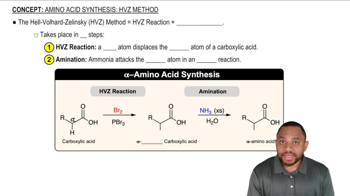
Amino Acid Synthesis: HVZ Method Concept 1

Reduction Reactions

Reduction reactions involve the gain of electrons or the decrease in oxidation state of a molecule, often resulting in the conversion of functional groups. In the context of amine synthesis, reducing agents can convert nitro groups to amines or azides to amines, effectively transforming the starting material while maintaining the carbon skeleton. Understanding these reactions is crucial for manipulating organic compounds.
Video consigliato:
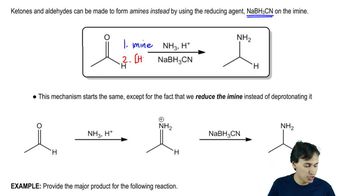
07:12
Reductive Amination

Nitrile Formation and Reduction

Nitrile formation involves the introduction of a cyano group (-C≡N) into a molecule, which can be achieved through various methods, such as nucleophilic substitution. The subsequent reduction of nitriles can yield primary amines, adding a carbon atom to the chain. This process is significant in organic synthesis, allowing for the construction of complex amine structures from simpler precursors.
Video consigliato:
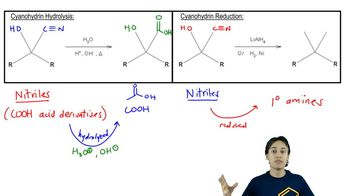
02:36
Nitrile Reduction
Pratica correlata
Domanda del libro di testo

Several additional amine syntheses are effectively limited to making primary amines. The reduction of azides and nitro compounds and the Gabriel synthesis leave the carbon chain unchanged. Formation and reduction of a nitrile adds one carbon atom. Show how these amine syntheses can be used for the following conversions.

(a) allyl bromide → allylamine 

867
views
Domanda del libro di testo

Show how you can synthesize the following tertiary amine three different ways, each using a different secondary amine and adding the final substituent by (b) acylation–reduction (3 ways).

1240
views
Domanda del libro di testo

The two most general amine syntheses are the reductive amination of carbonyl compounds and the reduction of amides. Show how these techniques can be used to accomplish the following syntheses.

(d) cyclohexanone → N-cyclohexylpyrrolidine

523
views
Domanda del libro di testo

Show how you can synthesize the following compounds starting with benzene, toluene, and alcohols containing no more than four carbon atoms as your organic starting materials. Assume that para is the major product (and separable from ortho) in ortho, para mixtures.

(a) pentan-1-amine

584
views
Domanda del libro di testo

Show how you can synthesize the following tertiary amine three different ways, each using a different secondary amine and adding the final substituent by

(a) reductive amination (3 ways).

622
views
Domanda del libro di testo

The two most general amine syntheses are the reductive amination of carbonyl compounds and the reduction of amides. Show how these techniques can be used to accomplish the following syntheses.

(c) pyrrolidine → N-ethylpyrrolidine

93
views