Ch. 19 - Amines
Wade - Organic Chemistry 9th Edition
Wade9th EditionOrganic ChemistryISBN: 9780135213728Non è quello che usi tu?Cambia libro di testo
Capitolo 19, Problema 40f

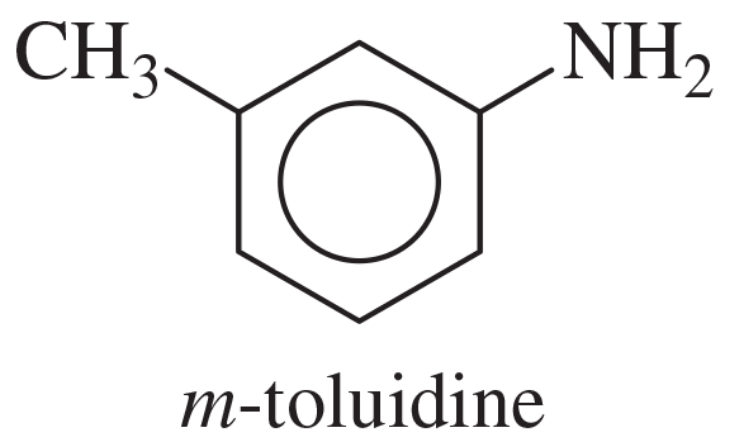
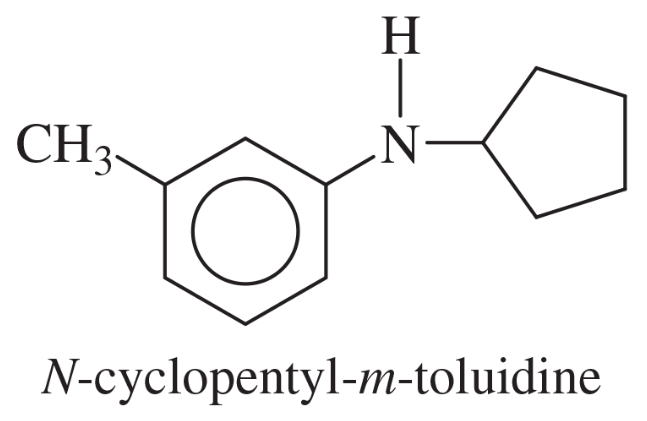
Show how m-toluidine can be converted to the following compounds, using any necessary reagents.

(f)

Guida verificata passo dopo passo
1
Step 1: Begin with m-toluidine, which has an amino group (-NH2) and a methyl group (-CH3) attached to a benzene ring in the meta position. The goal is to convert the amino group into an N-cyclopentyl group.
Step 2: Perform an alkylation reaction on the amino group. Use cyclopentyl bromide (C5H9Br) or cyclopentyl chloride (C5H9Cl) as the alkylating agent. This reaction typically requires a base, such as potassium carbonate (K2CO3), to neutralize the acid formed during the reaction.
Step 3: The reaction mechanism involves the nucleophilic attack of the lone pair on the nitrogen atom of the amino group (-NH2) on the electrophilic carbon of the cyclopentyl halide. This results in the formation of an N-cyclopentyl group attached to the nitrogen.
Step 4: Ensure the reaction conditions are mild to avoid over-alkylation or side reactions. The product formed will be N-cyclopentyl-m-toluidine, where the nitrogen is now bonded to the cyclopentyl group.
Step 5: Purify the product using techniques such as recrystallization or column chromatography to isolate N-cyclopentyl-m-toluidine in its pure form.

Risposta video verificata per un problema simile:

Questa soluzione video è stata consigliata dai nostri tutor come utile per risolvere questo problema.
Durata del video:
2m

Concetti chiave

Ecco i concetti essenziali che devi comprendere per rispondere correttamente alla domanda.

Amines and Their Reactivity

Amines, such as m-toluidine, are organic compounds derived from ammonia by replacing one or more hydrogen atoms with alkyl or aryl groups. They are nucleophilic and can participate in various reactions, including electrophilic aromatic substitution and acylation. Understanding the reactivity of amines is crucial for predicting the products of their transformations.
Video consigliato:
07:12
Reductive Amination

Electrophilic Aromatic Substitution

Electrophilic aromatic substitution (EAS) is a fundamental reaction in organic chemistry where an electrophile replaces a hydrogen atom on an aromatic ring. The presence of substituents, like the amino group in m-toluidine, influences the reactivity and orientation of the substitution. Recognizing how substituents direct EAS is essential for determining the products formed in the conversion of m-toluidine.
Video consigliato:
03:07
EAS Review

Functional Group Transformations

Functional group transformations involve converting one functional group into another through chemical reactions. In the context of m-toluidine, this may include oxidation, acylation, or alkylation processes. Mastery of these transformations is vital for synthesizing desired compounds from m-toluidine, as it allows chemists to manipulate the molecule's reactivity and properties effectively.
Video consigliato:
02:36
Identifying Functional Groups