Ch. 19 - Amines
Wade - Organic Chemistry 9th Edition
Wade9th EditionOrganic ChemistryISBN: 9780135213728Non è quello che usi tu?Cambia libro di testo
Capitolo 19, Problema 31a

Show how to prepare the following aromatic amines by aromatic nitration, followed by reduction. You may use benzene and toluene as your aromatic starting materials.
(a) aniline

Guida verificata passo dopo passo
1
Step 1: Begin with benzene as the aromatic starting material. Benzene is a simple aromatic compound with a six-membered ring and alternating double bonds.
Step 2: Perform aromatic nitration on benzene. This involves reacting benzene with a mixture of concentrated nitric acid (HNO₃) and concentrated sulfuric acid (H₂SO₄). The reaction introduces a nitro group (-NO₂) onto the benzene ring, forming nitrobenzene. The general reaction is: C₆H₆ + HNO₃ → C₆H₅NO₂ + H₂O.
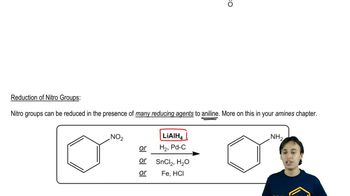
Step 3: Reduce the nitro group (-NO₂) in nitrobenzene to an amino group (-NH₂). This reduction can be achieved using reagents such as tin (Sn) and hydrochloric acid (HCl), or catalytic hydrogenation (H₂ with a metal catalyst like Pd/C). The reaction converts nitrobenzene to aniline (C₆H₅NH₂).
Step 4: If toluene is used as the starting material instead of benzene, the nitration reaction will preferentially occur at the ortho and para positions relative to the methyl group (-CH₃) due to its electron-donating nature. This results in a mixture of ortho-nitrotoluene and para-nitrotoluene.
Step 5: Reduce the nitro group in para-nitrotoluene to form para-toluidine (C₆H₄CH₃NH₂). This compound is structurally similar to aniline but contains a methyl group on the ring. If pure aniline is required, benzene should be used as the starting material.

Risposta video verificata per un problema simile:

Questa soluzione video è stata consigliata dai nostri tutor come utile per risolvere questo problema.
Durata del video:
3m

Concetti chiave

Ecco i concetti essenziali che devi comprendere per rispondere correttamente alla domanda.

Aromatic Nitration

Aromatic nitration is a chemical reaction that introduces a nitro group (-NO2) into an aromatic ring, typically using a mixture of concentrated nitric acid and sulfuric acid. This electrophilic substitution reaction is facilitated by the formation of a nitronium ion (NO2+), which acts as the electrophile. The position of substitution is influenced by the existing substituents on the aromatic ring, which can either activate or deactivate the ring towards further electrophilic attacks.
Video consigliato:
08:19
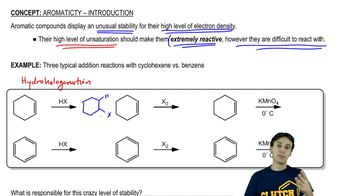
Intro to Aromaticity

Reduction of Nitro Compounds

The reduction of nitro compounds involves converting the nitro group (-NO2) into an amine group (-NH2). This transformation can be achieved through various methods, including catalytic hydrogenation or using reducing agents like iron and hydrochloric acid. The reduction process is crucial for synthesizing aromatic amines, as it allows for the functionalization of the aromatic ring, leading to compounds like aniline, which is a key building block in organic synthesis.
Video consigliato:
03:23
Reduction of Nitro Groups

Electrophilic Aromatic Substitution (EAS)

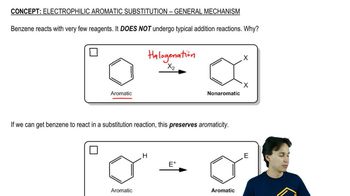
Electrophilic Aromatic Substitution (EAS) is a fundamental reaction mechanism in organic chemistry where an electrophile replaces a hydrogen atom on an aromatic ring. This process is characterized by the formation of a sigma complex (arenium ion) and is influenced by the nature of substituents already present on the ring. Understanding EAS is essential for predicting the outcomes of reactions involving aromatic compounds, such as the nitration and subsequent reduction to form aromatic amines.
Video consigliato:
03:07
EAS Review